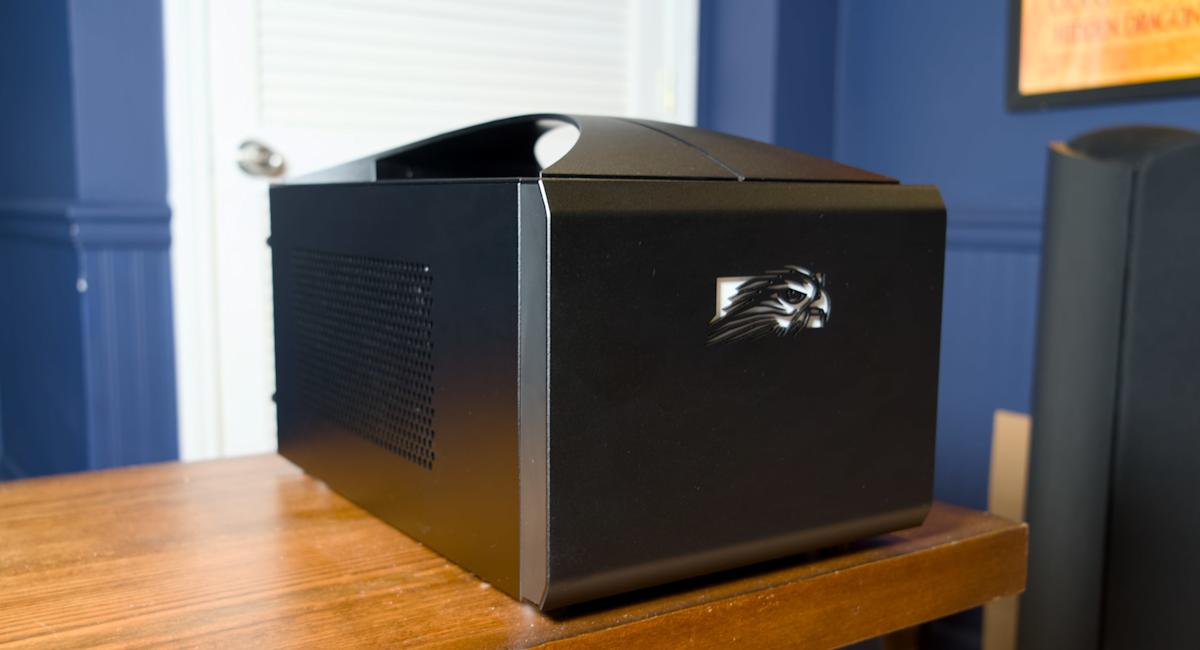
There comes a point in every PC gamer’s life where they stare at their massive, glowing mid-tower chassis and wonder if there isn’t a better way. A quieter way. A way that doesn’t involve a monolithic RGB box heating up their home office like a space heater.
According to Engadget is a web magazine with obsessive daily coverage of everything new in gadgets and consumer electronics, and their recent hardware testing highlighted a problem many of us face. Games like last year’s gorgeous Mafia: The Old Country practically beg to be played on a massive OLED screen. But dragging a massive desktop into the living room is a logistical nightmare. Consoles require visual compromises. So what do you do when you want zero compromises, 4K native rendering, and a box that actually fits under your TV?
You look at the small form factor (SFF) market. And right now, that market is telling us a very uncomfortable truth about the state of high-end computing.
Engineering a Miracle in 15 Inches
To understand the Falcon Northwest FragBox, you have to appreciate the sheer physical absurdity of what it achieves. Small form factor PCs are not new. Falcon themselves debuted the original FragBox way back in 2003. But the components we are dealing with today are vastly different beasts.
Modern graphics cards are comically large. The NVIDIA RTX 5090 is less a computer component and more a cinder block of silicon and copper. Squeezing that, alongside an AMD Ryzen 9950X3D and a 1,200W power supply, into a chassis that measures just 10.2 inches tall and 15.9 inches deep feels like a violation of physics.
Yet, it works. Beautifully.
The system pulls cold air in, blasts it through a 280mm all-in-one liquid radiator, and exhausts it out the top. The temperatures are frankly insulting to anyone who has spent weeks tweaking custom cooling loops in a massive tower. Under heavy load, the CPU sits at a chilly 52C while the RTX 5090 barely breaks a sweat at 65C. The fans are barely audible. It is a masterpiece of thermal engineering.
But this engineering marvel masks a grim reality for the average consumer.
The AI-Induced “RAMaggedon”
Let’s talk about the elephant in the room. Or rather, the $8,000 elephant sitting under the TV.
The base model of the FragBox starts at $3,997. That alone is a staggering entry fee. But if you want the configuration that actually justifies this level of thermal engineering—the RTX 5090, 96GB of DDR5 RAM, and a 2TB SSD—you are looking at a final invoice of $7,995.
Five months ago, in the autumn of 2025, this exact machine would have cost almost a thousand dollars less.
What happened? Enterprise AI happened.
The consumer PC hardware market is no longer driven by gamers. We are simply picking up the expensive scraps left behind by massive data centers hoovering up every available memory chip and GPU die on the planet.
Editorial Analysis
Late last year, the tech industry experienced what industry insiders casually dubbed the “RAMaggedon.” As tech giants raced to build localized AI infrastructure, the demand for high-speed memory and storage skyrocketed. A late 2025 report from TrendForce found that DDR5 memory contract prices spiked by nearly 20% in a single quarter as manufacturers shifted production lines to prioritize enterprise AI hardware.
Gamers are collateral damage in the AI wars.
Falcon Northwest, a boutique builder known for catering to wealthier clientele, simply has to pass these costs along. They aren’t gouging. They are surviving in a hardware economy that has fundamentally decoupled from the reality of the average consumer’s wallet.
The Gentrification of PC Gaming
There was a time when building or buying a high-end PC was a stretch, but an attainable one. You saved up, you waited for holiday sales, and you bought the best tier. Today, the ultra-high-end tier has entirely detached itself from normal pricing structures.
According to Jon Peddie Research, the high-end PC gaming hardware market generates tens of billions annually, but a massive portion of that revenue is concentrated among a shrinking demographic of extreme enthusiasts. The middle class of PC gaming is being squeezed out.
The FragBox is the perfect physical manifestation of this trend. It is stately. It lacks the garish, cheap-looking LEDs and cheesy thermal glass that dominate budget builds. Its thick aluminum panels feel like the door of a vintage luxury car. It even weighs 25 pounds—a dense, heavy brick of pure computing luxury.
It is a status symbol.
When you drop eight grand on a desktop, you aren’t just paying for frame rates. You are paying for the privilege of not having to compromise. You want Wi-Fi 7? It’s standard now. You want three M.2 SSD slots accessible by just unscrewing a side panel? Done. You want to hit 13,810 in PCMark 10, blowing past standard mid-tower scores? You’ve got it.
Living Room Hegemony
Is there a practical reason for this machine to exist? Actually, yes.
The dream of the living room PC has been around for over a decade. Valve tried it with Steam Machines and failed miserably. The hardware just wasn’t ready. SFF PCs were too loud, too hot, or too weak.
The FragBox proves that the hardware is finally capable of executing the dream flawlessly. It is small enough to fit on a TV stand. It is quiet enough not to ruin the audio of a quiet cinematic cutscene. And it is powerful enough to run any modern title at 4K with ray tracing cranked to the absolute maximum.
Despite recent hardware leaps, console gaming remains deeply entrenched. Recent demographic data from the Pew Research Center shows that dedicated consoles still dominate living room setups by a massive margin. People like the simplicity. They like the price tag. A PlayStation 5 Pro costs a fraction of the tax you’d pay just to buy the FragBox’s GPU.
But the FragBox isn’t trying to convert console gamers. It exists for the PC purist who refuses to accept the visual downgrade of a console, but who also refuses to let their living room look like a teenager’s bedroom.
A Beautiful Anomaly
I genuinely love that the FragBox exists. It pushes the boundaries of chassis design and thermal management. It forces us to rethink how much empty, wasted space exists inside standard desktop towers.
It also makes me a bit sad.
Reviewing a machine like this in 2026 feels a bit like reviewing a hypercar. You appreciate the engineering. You marvel at the speed. You note the impeccable build quality and the sheer horsepower under the hood. But you do so knowing that almost no one reading the review will ever actually own one.
The component crisis has turned the ultimate gaming PC into a luxury good. If you have the disposable income to weather the pricing storm, Falcon Northwest has built you the perfect machine. It does everything right. It stays cool, runs silent, and obliterates every benchmark you throw at it.
For the rest of us? We’ll just have to keep staring at our bulky mid-towers, listening to the fans spin up, and dreaming of a day when the tech industry cares more about gamers than data centers.
Is the Falcon Northwest FragBox upgradable?
Yes. Despite its incredibly dense footprint, the aluminum side and top panels can be easily removed. Users have full access to swap out the GPU, RAM, and storage. The system supports three M.2 SSDs, two 2.5-inch drives, and even a large 3.5-inch HDD.
Why did PC component prices spike so heavily in late 2025?
The tech industry experienced a massive supply chain shift due to the rapid expansion of enterprise AI. Manufacturing facilities prioritized producing high-margin memory and silicon for data centers, leading to a shortage of consumer-grade DDR5 RAM and GPUs. This squeeze dramatically inflated the cost of high-end PC builds.
Source material compiled from several news agencies. Views expressed reflect our editorial analysis.