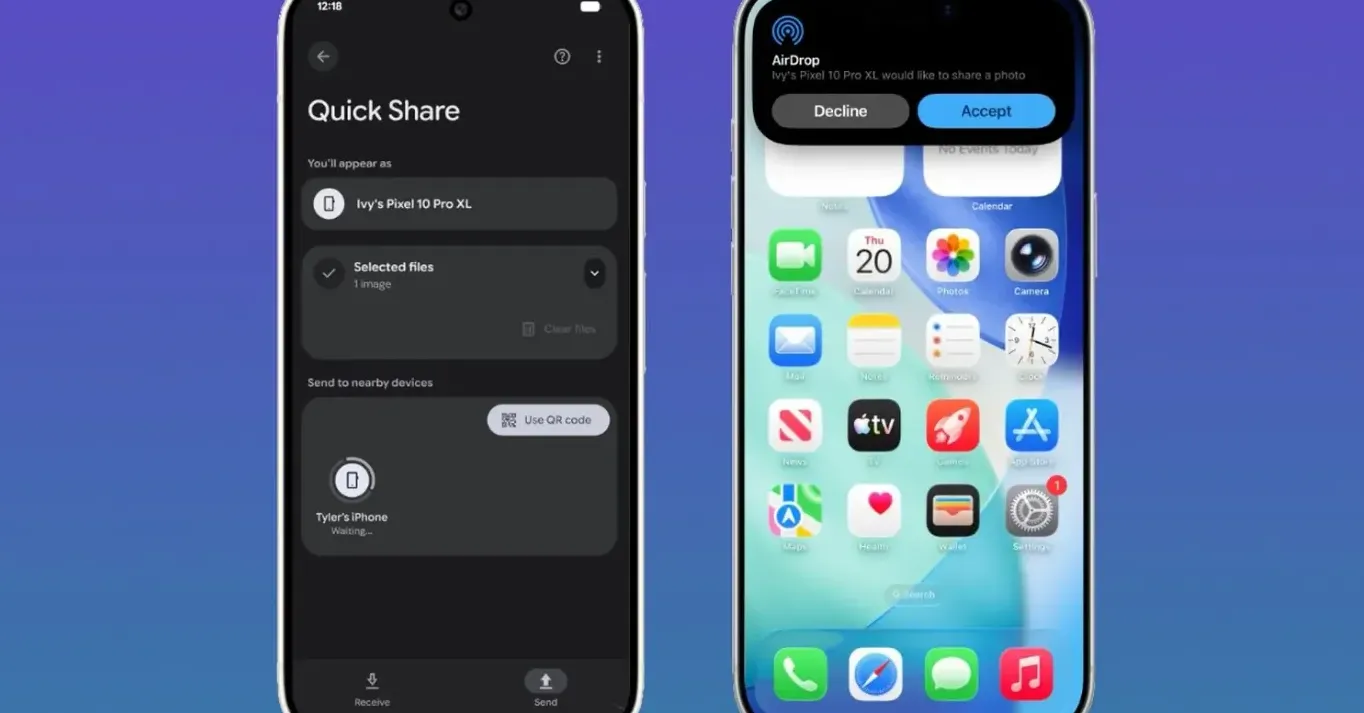
We’ve all been there. You’re at a dimly lit restaurant, the vibe is perfect, and your friend snaps a phenomenal group photo. Then comes the dreaded question: “Can you send that to me?” Pull out an Android while everyone else has an iPhone, and a collective groan typically follows. The photo gets squeezed through WhatsApp or Messenger, arriving on your screen looking like it was captured through a screen door in a rainstorm.
According to Telset, that frustrating little dance started becoming a relic of the past when Google introduced seamless cross-platform sharing with the Pixel 9. As of early 2026, the implications stretch well beyond trading vacation photos without obliterating the resolution. What this feature actually represents — when you sit with it for a moment — is a fundamental reordering of how the tech industry treats you as a paying customer.
For over a decade, tech giants erected invisible, impenetrable walls around their users. Apple had AirDrop. Android had a confusing, ever-shifting graveyard of sharing protocols. Getting them to communicate was practically a dark art. You’d email yourself files. You’d upload gigabytes of video to cloud drives just to text a link to the person sitting directly beside you. Exhausting doesn’t cover it.
The Pixel 9 rewrote that script entirely. By enabling a direct, high-speed file transfer to an iPhone, Google didn’t merely push a clever software update. They launched a psychological offensive against ecosystem lock-in — and the target audience noticed.
Apple Built a Club. Google Bought a Pair of Bolt Cutters.
To grasp why this matters, you have to examine the social mechanics of smartphone ownership over the last several years. Apple didn’t just sell phones; they sold club memberships. The perks of that club — iMessage, FaceTime, AirDrop — were engineered to operate flawlessly inside the walls and fail spectacularly outside of them.
Accidental? Hardly. A fall 2024 survey by Piper Sandler found that nearly 87% of US teens owned an iPhone at the time. For young people, the social pressure to remain inside the Apple ecosystem was suffocating. Being the green bubble in the group chat carried a known social penalty. Being the person who shattered the photo-sharing circle? That was its own special brand of humiliation.
AirDrop operated as the bouncer at the club door — fast, native, and deliberately exclusionary. Want to share files effortlessly in a college dorm or a corporate boardroom? Buy a Mac and an iPhone. Discussion closed.
Google spent years attempting to counter with their own bouncers. Android Beam required you to physically tap phones together like you were making them kiss. Then came Nearby Share, which worked adequately but only within Android’s own territory. In early 2024, Google and Samsung finally stopped competing with each other and merged their respective systems into a unified platform — a crucial first step, though still an Android-to-Android play. The wall between ecosystems remained stubbornly intact.
Why the Smartest Attack on Apple Wasn’t an Attack at All
Stealing market share rarely works through brute force. The smarter move — almost always — is making collaboration so painless that switching sides stops feeling necessary.
Consider the average household in 2026. Mixed-device reality is the norm, not the exception. Your partner might carry an iPhone while you swear by a Pixel. Your employer issues Macs; you run Windows at home. In that environment, artificial software friction doesn’t read as a premium brand experience. It reads as hostility — a company actively punishing you for living your actual life.
“You don’t beat a closed ecosystem by building a secondary closed ecosystem. You beat it by making the walls irrelevant. Google finally realized that interoperability is the ultimate Trojan horse.”
— Industry Tech Analyst
By giving the Pixel 9 the ability to push files directly to an iPhone via Quick Share, Google effectively dissolved the social penalty of owning an Android. No longer the broken link in the chain, you become the person taking stunning AI-enhanced low-light shots and handing the original, uncompressed files to your iPhone-toting friends without a second thought. The hub, not the outcast. That’s a quiet but seismic identity shift for Android ownership.
The Wireless Handshake Happening Three Feet Away From You
When actually tested in the field, the process is disarmingly simple — almost anticlimactic given how long this problem has festered.
Hit the share button on a Pixel 9, and the phone immediately begins scanning the surrounding area. Bluetooth Low Energy handles the initial handshake — essentially broadcasting into the void, “Who’s nearby and ready to receive?” Once the target device accepts, the heavy lifting shifts to Wi-Fi Direct technology, which forges a secure, temporary, peer-to-peer network between the two phones. No cellular data consumed. No routing through a server farm in California. Just a raw blast of data across the room at Wi-Fi speeds.
Your 4K concert video arrives looking exactly as crisp as it did on your own display.
There is, naturally, a catch — and it’s worth being honest about it. Because Apple would never voluntarily embed an Android sharing protocol into iOS, the iPhone recipient needs to download the Quick Share app from the App Store first. One-time setup. Thirty seconds, maybe. But still a step.
Is that friction? Yes. If you’re at a conference trying to drop a contact card on a stranger, asking them to install an app first is a tall order — the kind most people will refuse on principle. But examine your actual sharing habits honestly. The overwhelming majority of files you send go to the same three or four people: your spouse, your closest friend, a sibling. For those relationships — the ones that matter daily — a one-time thirty-second download permanently eliminates a recurring headache. The math isn’t complicated.
Regulators Swung the Sledgehammer First. Google Walked Through the Gap.
This move didn’t emerge from nowhere. The past couple of years have been genuinely brutal for tech monopolies trying to maintain closed borders, and the pressure came from multiple directions simultaneously.
Regulators, particularly in the European Union, have been dismantling these walls with methodical persistence. Apple was compelled to abandon their proprietary Lightning port in favor of USB-C. They were forced to crack open their NFC chips to third-party wallet developers. And in late 2024 — facing compounding pressure from both regulators and the market — Apple finally adopted Rich Communication Services (RCS) in iOS 18.
That RCS adoption was its own quiet earthquake. Suddenly, high-quality photos, typing indicators, and read receipts functioned between iPhones and Androids in standard text threads — features Android users had enjoyed for years, now no longer held hostage to ecosystem allegiance. The Pixel’s Quick Share bridge was the logical next stride: covering larger files, offline transfers, and the kinds of spontaneous, proximity-based sharing that RCS still can’t handle.
Taken together, these shifts paint an unmistakable picture. The walled garden model is eroding — not collapsing overnight, but losing ground in ways that compound. Consumers now expect their expensive devices to collaborate. When a company actively obstructs that expectation, what they breed isn’t loyalty. It’s resentment. Google read that resentment clearly and moved accordingly.
Frequently Asked Questions
Does Quick Share degrade photo or video quality?
No. Unlike sending media through SMS or heavily compressed messaging apps like WhatsApp, Quick Share transfers the original, uncompressed file using a direct Wi-Fi connection. Your 50-megapixel shots arrive with every pixel intact.
Do you need an active internet connection to share files this way?
Once the Quick Share app is installed on the receiving iPhone, no internet connection is required. The phones communicate directly with each other using local wireless hardware, making it well-suited for sharing files on airplanes or in areas with genuinely terrible cell reception.
Is this feature exclusive to the Pixel 9?
While Google heavily spotlighted this capability alongside the Pixel 9’s launch, Quick Share is a system-level Android feature. Most modern Android devices running updated software can access it, though discovery speeds and transfer stability in practice tend to perform most reliably on newer, premium hardware.
The Borders Were Always Artificial. Now They’re Admitting It.
Stepping back from where we sit today, the smartphone wars have visibly matured. Hardware is universally excellent across price tiers. Cameras are spectacular on devices that cost half what a flagship demands. The real contest is no longer about who engineers the brightest display or the fastest chip — it’s about who generates the least resistance in your actual daily routine.
Apple spent years persuading you that an iPhone was the only path to seamless connectivity. Google countered with a different thesis entirely: make their phones connect seamlessly with everything, regardless of whatever logo graces the back of the device sitting across the table.
Worth asking aloud: does interoperability ultimately hurt Google, or does it quietly expand their gravitational pull? Every iPhone user who installs Quick Share and discovers how effortlessly it works is, in some small but measurable way, now inside Google’s orbit. That’s not charity — that’s a long game.
If you’re still nursing an older handset, weighing whether to cross ecosystem lines, the calculus has shifted under your feet. The choice is no longer camera quality versus social belonging. You can buy the phone that actually fits your life, confident that the artificial borders once defining our digital existence are — finally, stubbornly, undeniably — coming apart at the seams.
A modest victory for common sense. Long overdue.
This article is sourced from various news outlets. Analysis and presentation represent our editorial perspective.