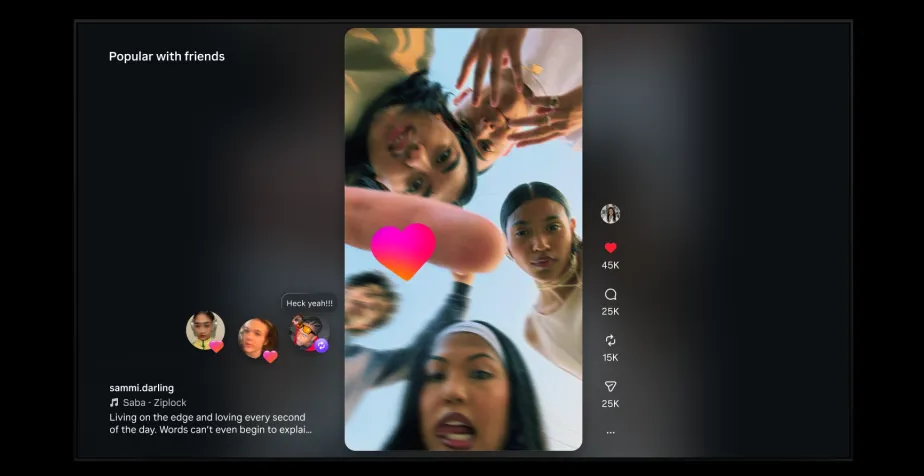
Ever caught yourself with a numb thumb after an hour of swiping through Reels? We’ve all been there — the modern digital trance, alive and well on every commute and every bathroom break. But what if you didn’t need your phone at all to get that quick hit of entertainment? According to Telset, that’s precisely what Meta has pulled off with the official rollout of Instagram for TV on Google TV devices. They want your eyes. Specifically, they want them fixed on the biggest, brightest screen in your house — the one you used to reserve for prestige dramas and playoff games.
This isn’t a minor app update. It’s a structural shift in how social media gets consumed. For years, platforms like Instagram and TikTok were militantly mobile-first — they lived in our pockets, rode the subway with us, kept us company in waiting rooms and, honestly, in the bathroom. Designed for distraction. Engineered for stolen moments.
Now they’re gunning for your deep-relaxation hours. When Meta quietly pushed the Instagram TV app to Amazon Fire TV late last year, it read like a cautious experiment. The aggressive expansion into the Google TV ecosystem makes the strategy impossible to misread: they aren’t just chasing idle commuters anymore. They actively want to displace your evening Netflix binge. All of it.
Your Remote Control Is the New Thumb
There’s an industry term for what happens when you watch a film or a traditional television show: “lean-back” viewing. You sink into the couch, press play, and let the content wash over you. Mobile phones, by contrast, are “lean-forward” devices — you swipe, tap, and make dozens of micro-decisions per minute. Active participation, even when it doesn’t feel like it.
Bringing short-form vertical video to a massive horizontal screen forces a collision between those two behaviors. And Meta, in practice, engineered a surprisingly elegant solution. Instead of requiring you to jab the remote every fifteen seconds, the content autoplays continuously. You pick a category — comedy, cooking, sports — and the algorithm takes the wheel entirely.
It mimics the ancient ritual of channel surfing, but turbocharged by a personalization engine that already has an unsettling read on what keeps your brain hooked. Old-school channel flipping was a lottery. This is a lottery where the house has studied your gambling patterns for years.
We used to flip through cable channels hoping to find something tolerable. Now, the TV flips through personalized micro-bursts of content, guaranteeing you never look away.
Consider the sheer friction that evaporates here. No device to hold. No neck strain. No thumb fatigue. You simply stare — an almost startlingly passive way to consume what was, until recently, a highly interactive medium. From a pure business standpoint? Absolute goldmine territory.
The Living Room Is the Last Fat Ad Dollar on the Table
Follow the money. Specifically, follow the connected TV (CTV) ad money, because that’s exactly what Meta is doing.
The mobile advertising market is saturated, and Apple’s privacy changes in recent years made user tracking substantially harder — a gut punch to Meta’s core revenue model. Television, oddly enough, has emerged as the new frontier for digital growth. A Nielsen report confirmed that streaming has thoroughly cannibalized traditional broadcast viewing, now commanding the lion’s share of total screen time among U.S. adults. Advertisers registered that shift, and budgets followed.
When an ad hits your phone, you can swipe past it in under a second — blink and it’s gone. When a fifteen-second unskippable spot plays on your 65-inch OLED, you’re a captive audience with nowhere to scroll. The CPMs (cost per mille — what an advertiser pays per thousand views) on connected TV run considerably higher than on mobile feeds, sometimes by a factor of three or four.
By porting Reels to Google TV and Fire TV, Meta instantly manufactures millions of new, high-value ad placements. The pitch to brands is almost laughably clean: “Skip the traditional TV buy. Run your Instagram campaign, and we’ll deliver it to the living room screen.” That’s a proposition Madison Avenue finds very hard to decline.
Meta Just Kicked In YouTube’s Front Door
Any honest conversation about the living room has to start with the reigning champion: YouTube.
For the better part of a decade, YouTube has owned user-generated video on television screens. Want to watch a 45-minute essay on the cultural legacy of a forgotten arcade game? YouTube, via your smart TV, was the answer. According to the Pew Research Center, YouTube remains the dominant video platform among U.S. adults — a position largely cemented by its seamless integration into smart TVs, streaming sticks, and gaming consoles.
Google built an enviable moat around that living room real estate. TikTok tried breaching it a couple of years ago with their own TV app — results were mixed, adoption lukewarm. Now Meta is arriving with considerably heavier artillery.
Crucially, Instagram isn’t trying to beat YouTube at long-form documentary content. It’s targeting the decision paralysis that YouTube increasingly produces. You sit down after a punishing workday, open Netflix, and spend twenty minutes scrolling without committing to anything. You pivot to YouTube, but the algorithm is surfacing hour-long podcast episodes and dense video essays. Exhausting, when all you wanted was to decompress.
Then the Instagram icon catches your eye. One click. Instantly, a funny dog video plays. Then a thirty-second recipe. Then a stand-up clip that’s actually sharp. Zero commitment required — no plot to follow, no characters to remember, no runtime to honor. It’s the digital equivalent of grazing instead of sitting down to cook a proper meal. Meta is betting that human laziness will consistently win the evening, and history suggests they’re not wrong about that.
When Your Algorithm Meets the Family Couch
Here’s the friction point Meta hasn’t fully solved — and it’s one that tech executives, who typically watch TV alone in sleek minimalist apartments, tend to underestimate badly: social context.
Our phones are deeply private objects. The Instagram algorithm knows your secret obsessions with unsettling precision. It knows you watch ASMR soap-cutting videos at 2 AM. It knows you linger on an ex’s vacation photos longer than you’d ever admit. It knows you have a genuine soft spot for terrible reality TV drama — the messier, the better.
Cast that hyper-personalized feed onto a 55-inch screen in a room where your spouse, your kids, or your roommates are parked on the same couch. Things get awkward fast. Genuinely awkward.
Television has historically been a communal medium — we gather around it for the big game, the season finale, the live event that everyone talks about at work the next morning. Reels are inherently solitary. Meta attempted to bridge that gap by allowing up to five separate account profiles to be logged in simultaneously on the TV app, mirroring the Netflix profile model. You can switch to your personal feed or spin up a clean “household” account that trains a fresh, untainted algorithm specifically for shared viewing.
Whether people actually want to watch short-form vertical video together is a genuinely open question — one the data hasn’t answered yet. The experience is disjointed by design. One person in the room finds a comedy sketch hilarious; the person beside them stares blankly because they lack the three layers of internet context needed to decode the joke. The rapid-fire switching that our individual brains handle effortlessly in private can feel chaotic and grating when imposed on a group with mismatched references and attention spans.
Creators Just Got Handed an Expensive New Problem
If you make videos for a living, the rulebook just got rewritten. Again.
For years, the creator economy ran on one commandment: optimize for mobile. Plaster big, bold text across the frame because viewers watch with sound off. Keep the camera tight on your face. Shoot in 9:16 vertical. Compress ruthlessly. Polish was optional — authenticity was the currency.
Now those same clips are being blown up to 4K resolution on massive screens with surround-sound home theater rigs behind them. Suddenly, audio quality is non-negotiable. A cheap clip-on microphone that sounded “fine” in an earphone sounds genuinely awful through a good speaker system. Heavy compression artifacts — invisible on a phone — look pixelated and amateurish on a 75-inch panel. The production shortcuts that defined the medium are about to become visible liabilities.
What’s coming, in all likelihood, is a pronounced split in how content gets produced. Top-tier creators will need to shoot their vertical videos on cinema-grade cameras, ensuring fidelity holds up when the content effectively broadcasts to a television audience. That pushes production costs sharply upward, gradually morphing casual bedroom creators into something resembling miniature television studios — complete with lighting rigs, audio treatment, and post-production workflows.
We watched this exact arc play out with YouTube roughly a decade ago. It opened with grainy webcam confessionals and evolved, under the pressure of audience expectation and platform competition, into multi-camera productions with dedicated editors and six-figure equipment budgets. Instagram is about to push its creator base through that same uncomfortable, expensive evolution — just compressed into a shorter timeline, because the platform moves faster now than YouTube ever did in its early years.
Will my mobile Instagram feed instantly show up on my TV?
Yes and no. Once you link your account, the TV app draws on your existing algorithm to serve content. That said, you have to actively open the app on your Google TV device — it doesn’t magically mirror from your phone unless you deliberately initiate it. You also have the option to build a clean, separate profile calibrated purely for the living room, which is worth doing if you’d rather not broadcast your more esoteric interests to whoever’s sharing the couch.
How do you interact with Reels on a television?
The remote becomes your thumb. The D-pad handles likes, pulls up the comment section (which appears alongside the video rather than overlaying it), and lets you share directly to connected friends. In practice, though, the app is built around passive consumption — if you sit there and do nothing, the next video autoplays without any input required from you.
Does this mean IGTV is coming back?
Not a chance. Meta officially retired the IGTV brand years ago, pivoting entirely to Reels. The TV app serves Reels and standard feed videos exclusively — there’s no appetite inside the company for returning to the long-form format that failed to gain traction. They’re committed to the infinite scroll of short clips, and the living room expansion doubles down on that bet rather than hedging it.
As of early 2025, the migration of short-form social video to the living room feels less like a surprise and more like an inevitability that somehow snuck up on us anyway. We’ve spent so much of our waking lives mainlining these feeds that their arrival on our largest screens was always a matter of when, not if. Google TV was the logical next domino after Amazon Fire TV — and it almost certainly won’t be the last platform Meta targets.
Whether this reshapes how families actually spend time together in the living room, or simply hands us a more passive way to zone out after a long day, is genuinely unclear. Both outcomes seem plausible. What isn’t unclear: the war for your attention just expanded its theater of operations considerably — and your couch is now contested ground.
Reporting draws from multiple verified sources. The editorial angle and commentary are our own.