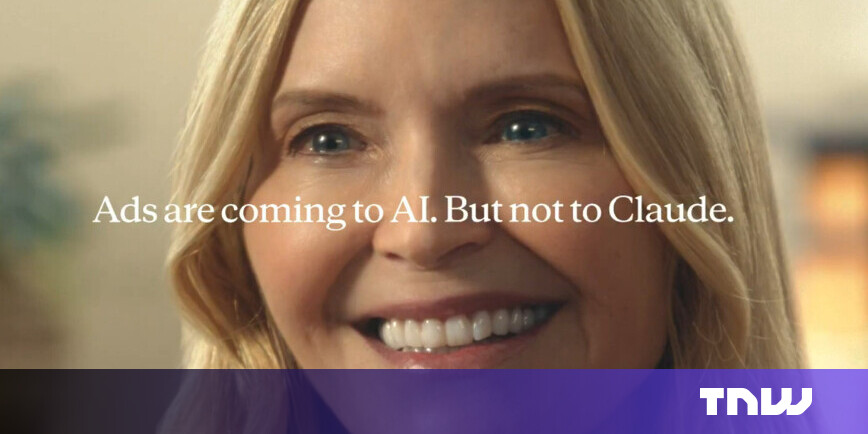
Look, we all know the routine by now. It’s early February, the confetti from the Super Bowl has barely settled, and we’re all busy dissecting the commercials with the same intensity we usually reserve for the fourth quarter. Typically, the morning-after water cooler talk revolves around beer spots, pickup trucks, or debating which A-list celebrity humiliated themselves the most for a quick paycheck. But this year? The conversation took a sharp, unexpected turn straight into Silicon Valley drama. According to a report from The Next Web, the most buzzed-about spot of the night wasn’t pitching a new flavor of Doritos. It was a direct, precision-guided hit from Anthropic, aimed squarely at the jaw of OpenAI.
If you happened to miss it while you were refilling the nachos or arguing about the halftime show, here is the gist of what went down. Anthropic dropped some serious cash to air a commercial that effectively roasted the entire concept of advertising within AI. The spot, titled “Can I get a six pack quickly?”, features a chatbot—clearly designed as a stand-in for ChatGPT—rudely interrupting a user’s query with a jarring, loud product pitch for breakfast cereal. It ends with a smug pivot to Claude, Anthropic’s own bot, promising a serene, ad-free existence.
It was funny, sure. It was undeniably punchy. And if we are being completely honest with ourselves, it was a little bit nasty. But beneath the humor lies a massive shift in how these tech giants are fighting for our attention. We have officially moved past the “my model is smarter than yours” phase of the AI wars and straight into a battle for the moral high ground. But we have to ask: is this ad a righteous stand for a better user experience, or is it just a clever sleight of hand designed to distract us from the brutal economics of running these machines?
Fighting a Ghost: The Art of the Straw Man
Let’s take a beat to look at what Anthropic actually pulled off here. They took a very real, simmering concern—the inevitable monetization of AI—and turned it into a ridiculous caricature. The commercial depicts an absolute nightmare scenario: you are trying to get actual work done, and your AI assistant suddenly starts screaming about sugary cereal. It is the pop-up ad hellscape of the early 2000s, reimagined for the generative age.
It is incredibly effective marketing because it taps into a visceral annoyance we all share. Nobody, and I mean nobody, wants their train of thought derailed by a clumsy sales pitch. But here is the rub: that scenario is almost certainly not what OpenAI is actually planning.
OpenAI has certainly signaled that ads are coming to the free tier of ChatGPT. However, the reality of modern advertising is far more subtle—and perhaps more insidious—than a bot blabbering about cereal mid-sentence. We are likely looking at something much quieter: sponsored citations, discreet sidebar placements, or “suggested follow-ups” that gently steer you toward a partner brand. By portraying the “ad-supported future” as a clumsy, intrusive mess, Anthropic is effectively fighting a straw man.
Sam Altman, CEO of OpenAI
Anthropic’s portrayal is clearly dishonest. We won’t implement ads in the intrusive way the ads suggest.
Sam Altman’s reaction was swift and noticeably defensive, calling the ad “dishonest.” And frankly, he has a point. But in the court of public opinion—especially during the Super Bowl, where nuance goes to die—Anthropic won the moment. They painted a vivid picture of a dystopian, ad-cluttered future and positioned Claude as the only sanctuary. It is classic brand positioning 101: define the enemy before they can define themselves.
The Billion-Dollar Elephant in the Server Room
Why is this happening right now? Why are we suddenly talking about ads invading our chatbots? It comes down to one boring, inescapable word: economics.
Running these large language models is excruciatingly expensive. We aren’t just talking about keeping the lights on; we are talking about burning through capital at a rate that makes 1980s Wall Street look frugal. A report from SemiAnalysis back in 2023 estimated that running ChatGPT cost upwards of $700,000 per day. Now, fast forward to 2026, and with the massive models we see today, those costs haven’t exactly plummeted. Inference costs—the raw compute power required to answer your specific question—remain the single biggest barrier to profitability.
Both OpenAI and Anthropic are currently burning cash to capture market share. But they have taken vastly different paths to solvency.
OpenAI, backed by the deep pockets of Microsoft, has gone fully mass market. They have the biggest user base by far, and to monetize that base without putting up a hard paywall that locks out 90% of the world, ads are the logical next step. It is essentially the Google model all over again: give the amazing tech away for free, and let advertisers subsidize the compute bills.
Anthropic, heavily backed by Amazon and Google, is trying to position itself as the “premium” alternative. Think of them as the “Apple” to OpenAI’s “Android,” if you will. By swearing off ads, they are placing a bet that users—specifically enterprise users and power users—will be willing to pay a premium for a clean, quiet, and private workspace.
Is This Principles or Just Marketing?
This is where things get a little cynical. Anthropic isn’t just selling a product here; they are selling a philosophy. They have always branded themselves as the “safe” AI company, the ones with “Constitutional AI” and a heavy focus on alignment. This Super Bowl ad is really just an extension of that brand halo.
The message they are sending is simple: “They (OpenAI) are sellouts who will clutter your screen and sell your attention. We (Anthropic) are the principled guardians of your focus.”
It is a powerful narrative. But is it sustainable? If Claude remains free for a large tier of users, Anthropic has to pay for those queries somehow. If they aren’t using ads, they are burning venture capital. Eventually, the bill comes due. Unless they plan to severely cripple their free tier or eliminate it entirely, the math is incredibly tough.
According to data from Statista, the global digital advertising market was projected to cross $700 billion recently. That is a massive pot of gold that is hard to ignore when your server bills are in the billions. OpenAI is dipping a toe in; Anthropic is proudly declaring they won’t touch it. For now, at least.
The Silent Promise: Privacy as a Product
There is another layer here that the ad hints at but doesn’t explicitly say: data privacy. Advertising models usually rely on tracking. If ChatGPT is serving you ads, it is likely using your conversation history to target those ads. If you’re asking about hiking boots, and it shows you a North Face ad, that implies a data loop exists.
Anthropic’s “no ads” stance is really a proxy for “we don’t snoop.” For enterprise customers, lawyers, and developers, this is huge. They don’t want their proprietary code or sensitive legal briefs being chewed up by an ad algorithm.
However, we need to be careful not to confuse “no ads” with “total privacy.” Just because a platform doesn’t show ads doesn’t mean it isn’t training on your data (unless you opt out). The ad simplifies a complex privacy landscape into a binary choice: Ads = Bad, No Ads = Good. It is effective storytelling, but it’s not the whole truth.
So, What Does This Mean for Us?
Where does this leave the average user in 2026? Honestly, it leaves us with more choices, which is rarely a bad thing. We are seeing a divergence in the market that mirrors the web 2.0 era.
On one side, you have the ad-supported, universally accessible model (OpenAI/Google). This ensures that AI isn’t just a luxury for the wealthy. Students, researchers in developing nations, and casual users get access to state-of-the-art intelligence, effectively subsidized by Ford and Coca-Cola.
Then you have the subscription-heavy, privacy-focused model (Anthropic). You pay with money instead of attention. It is a cleaner experience, undoubtedly, but it creates a gated community of intelligence.
What makes this Super Bowl stunt so fascinating is that it proves AI has truly hit the mainstream. We aren’t arguing about parameters or benchmarks anymore. We’re arguing about brand values on national television. Anthropic spent millions not to explain how Claude works, but to explain who Claude is.
The Verdict: A Brilliant Battle, But the War is Just Starting
Anthropic’s ad was a brilliant tactical strike. It forced OpenAI into a defensive crouch and framed the conversation entirely on Anthropic’s terms. It made “ads in AI” a dirty concept before OpenAI could even properly roll them out.
But let’s not kid ourselves. This isn’t a battle between good and evil. It is a battle between two different business models, both desperate to recoup massive investments. Today, Anthropic is the ad-free hero. But in the tech world, heroes have a funny way of becoming villains once the IPO pressure hits.
For now, enjoy the silence on Claude. But keep an eye on that interface. In the war for profitability, promises are often the first casualty.
This article is sourced from various news outlets. Analysis and presentation represent our editorial perspective.