I still miss Dark Sky. Most of us do. When Apple swallowed it whole back in 2020 — and finally killed the standalone app two years later — a lot of us were left standing in the rain. Literally. The native iOS Weather app absorbed some of the underlying technology, sure. But the soul evaporated. What remained was just another corporate utility: sterile, occasionally wrong, and completely stripped of the hyper-local precision that had earned Dark Sky a permanent spot on millions of home screens.
According to Engadget, the original minds behind Dark Sky didn’t quietly retire. As of early 2025, they’d spent several years building something new. Something sharper.
It’s called Acme Weather. And it takes direct aim at the single biggest deception in modern meteorology: the performance of absolute certainty.
Weather Apps Have Been Lying to You. These Designers Finally Said So.
For the better part of a decade, weather apps have conditioned us to expect a level of precision that the atmosphere simply refuses to deliver. Open almost any default weather app right now. It announces a 40% chance of rain at 3:00 PM with the calm confidence of a surgeon. Clean. Definitive. Scientific-sounding. You glance at that tidy little cloud icon and rearrange your afternoon around it.
Usually, it’s one algorithm making a wildly educated guess from a single meteorological model.
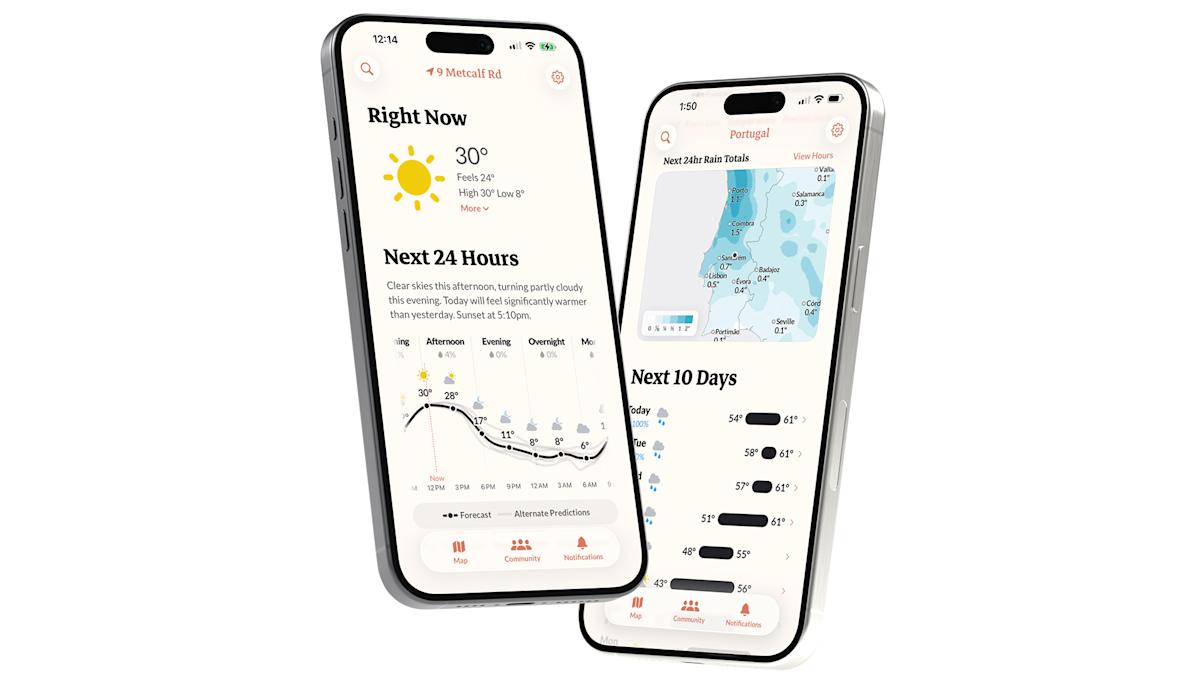
Acme Weather pitches that false confidence straight into the bin. Rather than presenting a single, stubborn forecast line, the app deploys a feature called Alternate Predictions — exposing the messy underlying reality of weather modeling by surfacing a bundle of possible outcomes mapped across your day. Ensemble forecasting, essentially, dragged down from the realm of meteorologists into something a regular person can actually read at a glance.
When those forecast lines huddle tight together on the graph, the app is practically broadcasting its confidence. The models are in agreement. Leave the umbrella at home. But when they scatter into a chaotic, tangled web? That’s Acme throwing up its hands — explicitly telling you that the computer models are in violent disagreement with each other. Honestly? That kind of candor is rare.
Consumer software admitting it doesn’t know something. Think about how seldom that happens. Tech companies typically bend over backward to paper over the seams in their data, operating on the assumption that users will panic if they glimpse the machinery. By trusting us with the uncertainty instead, Acme paradoxically builds more confidence in the forecast overall. You know precisely when to gamble on a picnic and when to book the indoor table.
The Crowdsourced Storm Chasers Living in Your Zip Code
Algorithms and radar towers can only take forecasting so far. That’s where human eyeballs come in — specifically, the ones attached to people already standing outside in whatever is actually happening.
Acme bakes real-time community reporting directly into the core experience, doing for rain clouds what crowdsourced traffic reporting once did for gridlocked highway commutes. Drop a quick emoji to flag sudden hail, a flash flood creeping up a side street, or a sky that’s clearing faster than the radar predicted. This ground-level chatter actively corrects the forecast when conditions shift faster than a radar sweep can register — which, in practice, turns out to be more often than most people realize.
We’re trying to build a system that relies on community truth just as much as radar pings. It’s about combining cold atmospheric data with human reality on the ground.
— Jack Grossman, Acme Weather
And that kind of ground-level truth? We desperately need it. Per the National Oceanic and Atmospheric Administration (NOAA), extreme and unpredictable localized weather events have climbed roughly 20% over the last decade. Leaning purely on a centralized radar tower sitting 40 miles away doesn’t cut it anymore when a micro-burst can flood your block while the street one neighborhood over stays bone dry.
The obvious vulnerability here is garbage data. Anyone who has spent time with a crowdsourced app knows that people will tap buttons just to see what happens — boredom, mischief, sheer curiosity. But Acme appears to be banking on sheer report volume to smooth out the noise. If one person claims it’s snowing in July while fifty others in the same zip code are logging bright sunshine, the system knows exactly whose report to discount. Volume, in this case, is the quality filter.
A Map That Moves Like Weather Actually Does
Before Apple and Google absorbed the indie weather ecosystem, there was a genuinely vibrant scene — small teams competing fiercely on design, typography, radar parsing, and the tiny details that power users obsessed over. Apple’s acquisition of Dark Sky sent a clear signal: weather was now a commodity. A background utility. Nothing a boutique team needed to keep fussing over.
That years-long stagnation is precisely why Acme Weather feels so necessary right now. A small, tightly focused team, it turns out, can still out-design a trillion-dollar company — simply by caring more about the person holding the phone.
Take the map layer. Like most capable weather apps, Acme delivers radar, lightning strikes, rain and snow accumulation, and wind patterns. Standard stuff on paper. But the execution here feels noticeably different from the sluggish, stuttering radar loops most of us have learned to tolerate. The map is fluid. Scrub through the timeline and it doesn’t choke. And because the app is so philosophically committed to showing multiple possible futures rather than one ordained truth, viewing the radar feels less like examining a static photograph and more like watching something genuinely alive — a system breathing, shifting, hedging its own bets.
Small thing. Significant difference in how you actually trust what you’re seeing.
Push Notifications Reimagined for People Who Are Tired of Being Screamed At
Beyond the forecasting engine, Acme is quietly attempting to fix one of the most broken corners of the smartphone experience: push notifications.
Most weather alerts arrive in one of two flavors — uselessly vague or ear-splittingly alarmist. Acme leans into smart, granular alerts that treat your time as something worth respecting. Government emergency alerts, community-flagged flash floods, a sudden wind shift that could derail your evening bike ride — the app surfaces these with context rather than raw panic. Grossman has described the goal as ensuring you never get blindsided by a downpour you could have seen coming.
But here’s where it gets unexpectedly charming.
Through an experimental opt-in tier called “Acme Labs,” users can sign up for alerts about impending rainbows or particularly photogenic sunsets. It’s a tiny feature. Delightful, even. And it’s a deliberate reminder that weather isn’t purely a logistical obstacle to manage — sometimes the sky is just doing something worth stepping outside to see. That philosophical nudge, small as it is, says something about what kind of app the team actually wants this to be.
Twenty-Five Dollars to Never Get Soaked Again. Is That a Bargain?
So. Is it worth paying a subscription for the weather?
Acme Weather runs $25 a year after a two-week free trial. In a digital world where Apple and Google serve up the temperature as a default freebie, a subscription fee triggers immediate skepticism in a lot of people — and fairly so. Subscription fatigue is real. We’re all quietly drowning in monthly charges for software we half-use, and adding another line item to that list requires genuine justification.
The value case, though, is harder to wave away than it first appears. A 2024 report from the Pew Research Center found that over 80% of smartphone users check weather apps daily — making it one of our most deeply ingrained digital habits. We consult the weather more frequently than we text most of our friends. Given that, the question shifts: if you’re going to stare at something every single morning, shouldn’t it be something that’s actually honest with you?
For outdoor runners, daily commuters, weekend hikers, or anyone simply exhausted by a default app that confidently lied about Tuesday afternoon — $25 is roughly the price of one soaked jacket. Or one ruined pair of suede shoes. The iOS version is already live, and the Android release has rolled out to users as well.
Dark Sky is gone. It isn’t coming back. But its ghost is haunting our phones again — and this time, it arrived carrying something the original never quite managed to offer so explicitly: the courage to say “we’re not sure.” In a category built on false confidence, that might be the most radical feature of all.
Is Dark Sky ever coming back?
No. Apple permanently shuttered Dark Sky in 2022 after absorbing its technology into the native iOS Weather app. Acme Weather is an entirely separate application — built from the ground up by the same original development team to fill the void that closure left behind.
Do I have to pay to use Acme Weather?
The app offers a two-week free trial, giving you time to actually test the Alternate Predictions feature and the community reporting tools before committing. After that window closes, it requires a $25 annual subscription to keep access.
Reporting draws from multiple verified sources. The editorial angle and commentary are our own.