I can still vividly recall sitting in my living room back in 2019, the curtains drawn tight to block out the sun, staring at those cold, brutalist concrete walls of the Oldest House. I remember wondering right then if Remedy Entertainment could ever actually top that very specific, very suffocating brand of claustrophobic dread. It turns out, as it usually does with Sam Lake and his team, that they didn’t need to reinvent the wheel—they just needed to step outside and see what the rest of the world looked like through a fractured lens. According to Engadget—which, if you follow them, you know is a web magazine with obsessive daily coverage of everything new in gadgets and consumer electronics—the first extended gameplay trailer for Control Resonant has finally dropped. And honestly? It’s a dizzying, beautiful reminder that Remedy is playing a completely different game than almost everyone else in the industry right now.
We’ve officially hit February 2026, and the buzz surrounding this sequel has been a slow, agonizing burn ever since that initial reveal late last year. But seeing Dylan Faden—the troubled, Hiss-corrupted brother we spent the entirety of the first game trying to “save”—stepping into the protagonist role is a pivot I genuinely didn’t see coming. Yet, the more I think about it, the more it feels entirely right. Jesse was the Director; she was the authority, the one trying to desperately put the lid back on the jar before everything spilled out. But Dylan? Dylan feels like the guy who’s already seen exactly what’s inside the jar, and he isn’t quite sure if he wants to close it or just let the whole world take a long, deep whiff of the chaos.
The Oldest House was a cage—but Manhattan is a playground for the impossible
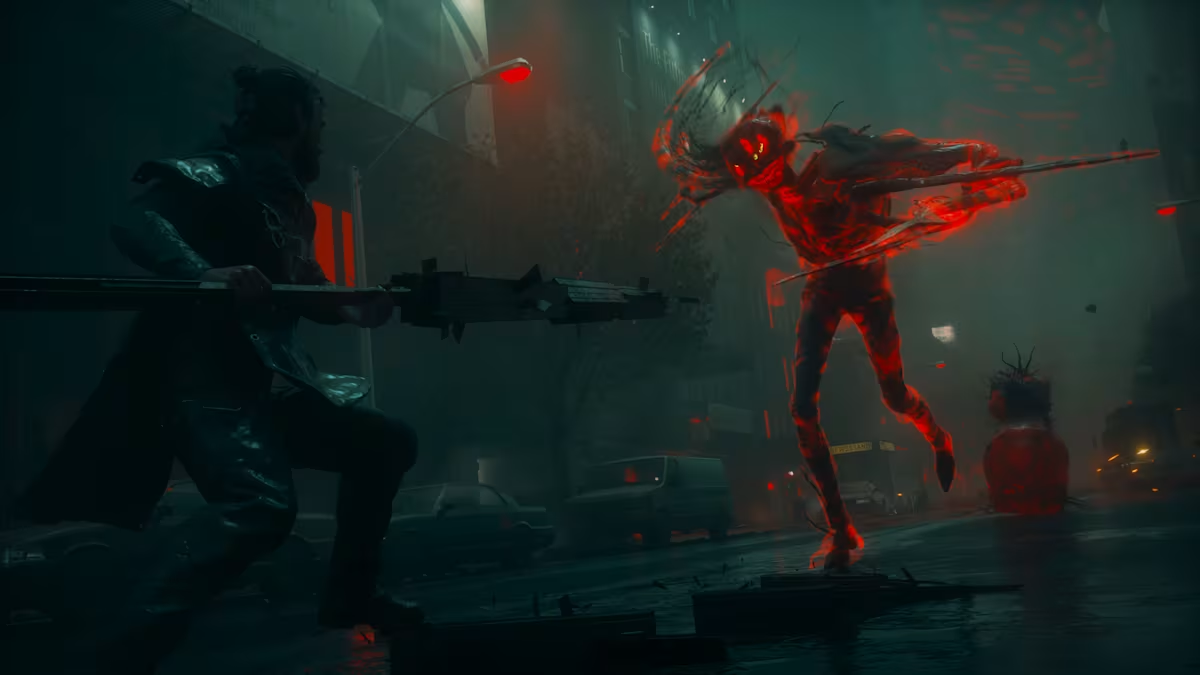
The original Control was, in my mind, a masterclass in interior design and spatial storytelling. It managed to turn mundane office cubicles and sterile mailrooms into these terrifying arenas of cosmic horror. But Control Resonant takes that same twisted logic and applies it to the massive, sprawling scale of Manhattan. The trailer gives us a look at a New York City that has been “Resonated,” and let me tell you, it’s not just some cheap visual filter or a bit of weird lighting. We’re talking about iconic skyscrapers that don’t just reach for the clouds—they bend and lurch at impossible 90-degree angles until they literally become the horizon. Seeing Dylan sprint up the side of a classic brownstone as if he’s just taking a casual Sunday stroll through Central Park is the kind of physics-defying spectacle that makes you realize just how much the Northlight engine has evolved over the last few years.
But it’s not just about the “wow” factor or the technical wizardry, though there’s plenty of that. There’s a real psychological weight to this new setting that I find fascinating. In the first game, the Federal Bureau of Control was a controlled environment—or at least it was trying its best to be. NYC is the opposite. It’s chaos. It’s public. It’s messy. According to a 2024 report from Digital Bros, the original Control sold over 4 million units, a figure that proved there is a massive, mainstream appetite for “New Weird” fiction. By moving the sequel out of the basement and into the streets, Remedy isn’t just expanding the map; they’re expanding the stakes. This isn’t a secret government cover-up anymore. This is everyone’s problem now, and there’s nowhere left to hide.
“We wanted to challenge the player’s perception of what ‘ground’ actually means. If the world is shifting, your tactics have to shift with it.”
— Remedy Creative Lead during the State of Play Presentation
The gravity-shifting mechanics we saw look remarkably fluid, almost second-nature. Dylan doesn’t just fly in the way Jesse did; he seems to reorient his personal gravity entirely. It’s a subtle distinction, sure, but it fundamentally changes the geometry of every single encounter. You’re not just scanning the room for cover; you’re looking for a new floor. If a Resonant creature is raining fire down on you from what used to be a roof, you don’t just hide—you make that roof your floor and charge. It’s aggressive, it’s lightning-fast, and I suspect it’s going to be an absolute nightmare for anyone who suffers from motion sickness. But for the rest of us? It looks like a total dream.
Swapping the Service Weapon for something a lot more… organic
One of the most striking changes in the trailer has to be the weaponry. Jesse had the Service Weapon—that sleek, shifting firearm that felt like a badge of office, a tool of the Director. Dylan, however, has the Aberrant. It looks more organic, more volatile, and decidedly more violent than anything Jesse carried. The shift toward heavy melee combat is a incredibly brave move for a series that felt so defined by its third-person shooting mechanics. In one sequence, we saw Dylan morph the Aberrant from a massive, concrete-crushing hammer into a pair of jagged, shimmering blades in a matter of seconds. It’s brutal, and it looks fantastic.
This shift tells me a lot about who Dylan is as a character, too. He’s not a “Director.” He’s a survivor with a direct, raw, and perhaps dangerous connection to the forces Jesse was only just beginning to understand. The combat looks so much more intimate this time around. You’re getting up close and personal with these Resonant creatures, feeling the visceral impact of every single strike. It reminds me a bit of how Alan Wake 2 slowed things down to make the horror feel more personal, but Control Resonant seems to be doing the exact opposite—cranking the speed up to make the power fantasy feel even more dangerous and unpredictable.
A 2025 Statista report noted that the action-adventure segment continues to dominate the console market, accounting for nearly 31% of total game sales. Remedy obviously knows this, but they’ve never been the type of studio to just follow the “Ubisoft towers” model of open-world design. The warped NYC we saw isn’t just an open map to be cleared; it’s a giant, city-sized puzzle. How do you navigate a city where the subway tunnels might lead you directly to the top of the Empire State Building? That’s the kind of environmental storytelling that keeps me up at night just thinking about the possibilities.
Dylan Faden isn’t just a protagonist; he’s a liability, and that’s why I love it
Let’s take a second to talk about Dylan himself. For most of the first game, he was essentially a MacGuffin—a goal to be reached, a brother to be found. When we finally did find him, he was… well, he was a total mess. He was a vessel for the Hiss, a man whose very identity had been stripped away by the Bureau’s cold experiments and various supernatural entities. Choosing him as the lead for the sequel is a stroke of genius, mostly because it allows Remedy to explore the “grey” areas of their universe. Jesse is a hero, plain and simple. Dylan? Dylan is a giant question mark.
In the trailer, his movements are twitchy, almost animalistic compared to Jesse’s disciplined, military-adjacent posture. He talks to the Resonant creatures as if he actually understands them—or maybe as if he’s already one of them. This opens up some fascinating narrative doors that I can’t wait to walk through. Are we playing as a hero trying to save New York, or are we playing as a catalyst for even more reality-bending change? The end of the PlayStation blog post promised that “things are going to get weirder,” and with Dylan at the helm, I actually believe them. He’s the perfect lens through which to view a world that has completely lost its mind.
And let’s be honest, there’s something deeply satisfying about finally playing as the “black sheep” of the family. We’ve spent years seeing Dylan through Jesse’s eyes—as a victim, a threat, or a tragedy. Now, we finally get to see the world through his. It’s going to be messy, it’s going to be loud, and I suspect it’s going to be a lot more emotional than the first game’s somewhat detached, bureaucratic tone. And frankly, I’m here for it.
The 2026 launch and the expanding “Remedy Connected Universe”
Remedy is still claiming they are on target for a 2026 release. In the high-stakes world of AAA development, that feels like it’s right around the corner, especially when you consider the sheer scope of what they showed in this trailer. They’ve been on an incredible roll lately, and the confidence in this footage is palpable. They aren’t trying to fix what wasn’t broken; they’re trying to evolve the entire experience into something entirely unrecognizable yet strangely familiar.
I also can’t help but look for the breadcrumbs. Is Alan Wake out there somewhere in this warped version of NYC? Are we going to see more of the FBC’s reach now that they’ve been forced outside of the Oldest House? The trailer didn’t give away any major cameos—they’re smarter than that—but the atmosphere is thick with that shared-universe DNA. The way the Resonant creatures move—jittery, phase-shifting, and vaguely human—feels like a direct evolution of the Hiss, but with a more localized, urban flair that feels unique to this setting.
There’s a specific kind of magic that happens when a developer stops worrying about being “grounded” and just leans entirely into the absurdity of their premise. Control Resonant looks like it has completely abandoned the safety rails. It’s a game where the sky can be the floor, your own arm can become a hammer, and your protagonist might very well be the villain of someone else’s story. It’s exactly the kind of big-budget weirdness that the industry needs more of right now.
Is Jesse Faden in Control Resonant?
While the game focuses heavily on her brother Dylan, Remedy has dropped several hints that Jesse’s role as Director will still be central to the overarching plot. She might not be the primary playable character this time around, but her influence over the FBC and her connection to Dylan are too big to ignore.
Do I need to play the first game to understand this one?
Remedy usually does a good job of making their sequels accessible to newcomers, but given that Dylan’s entire backstory was a major mystery in the first game, you’ll definitely get a lot more out of the narrative if you’ve experienced the events of the Oldest House first. Plus, it’s just a great game.
What exactly is the “Aberrant” weapon?
Unlike Jesse’s Service Weapon, which was primarily a firearm that changed shapes, the Aberrant is a much more visceral, shapeshifting melee tool. It allows Dylan to switch between hammers, blades, and other close-quarters forms on the fly, making the combat feel much more personal and physical.
Final thoughts on a world turned upside down
As the trailer wrapped up with that lingering, haunting shot of Dylan standing on the vertical side of a skyscraper, looking out over a horizon that absolutely shouldn’t exist, I felt that familiar itch. It’s the itch to explore corners that shouldn’t be there and to pore over lore documents hidden in the wreckage of a reality that’s coming apart at the seams. Remedy has a way of making the impossible feel tactile and real, and Control Resonant seems poised to be their most tactile, “hands-on” experience yet.
We’ve still got a bit of a wait before we can actually get our hands on the Aberrant and start flipping gravity for ourselves, but if this gameplay reveal is anything to go by, the wait is going to be worth every single second. New York has been the setting for a thousand different games, but I can honestly say we’ve never seen it like this. And frankly, I don’t think I’ll ever look at a Manhattan street corner the same way again.
It’s a bold, risky new direction for a series that was already pretty far out there. But then again, “out there” is exactly where Remedy belongs. If things are going to get weirder, all I can say is: bring it on. I’m ready.
This article is sourced from various news outlets. Analysis and presentation represent our editorial perspective.