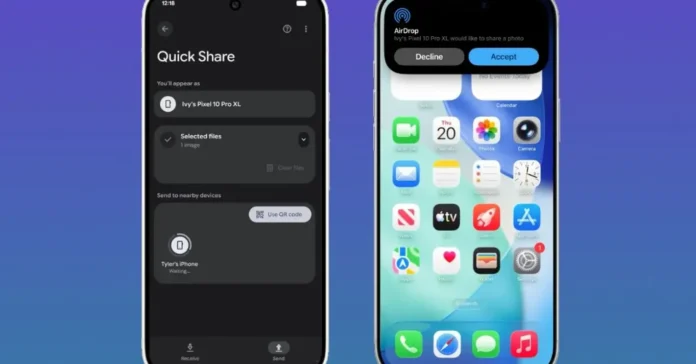
For the longest time, sharing a high-resolution video between an Android and an iPhone felt like trying to fax a sandwich. It was a clunky, infuriating process. You either sacrificed all visual fidelity by texting it, or you embarked on a multi-step quest involving Google Drive links, expiring cloud uploads, or sketchy third-party apps.
According to Telset, Google made a calculated, aggressive move with the Pixel 9 series to completely dismantle this artificial barrier. And looking back from where we sit today in early 2026, it is clear that this wasn’t just a software update. It was a Trojan horse.
By upgrading Quick Share to communicate directly with iOS devices, Google didn’t just solve a minor technical annoyance. They launched a quiet offensive against Apple’s most potent weapon: social friction. And the fascinating part? They did it by being the nice guy.
The Manufactured Divide
To understand the gravity of Google’s maneuver, we have to look at why the wall existed in the first place. Apple’s ecosystem is arguably the most successful customer retention tool in modern corporate history. A 2024 survey by Consumer Intelligence Research Partners found that Apple’s smartphone customer retention rate consistently hovered around the mid-90s percentile. People weren’t just staying for the camera or the processor. They were staying because leaving meant getting exiled from the social fabric.
AirDrop. iMessage. Shared iCloud Albums. These features worked flawlessly, provided everyone in your circle paid the toll and bought an iPhone. The moment a green bubble entered the chat, or someone pulled out an Android to share a photo, the entire system degraded. This was by design. The friction was the feature.
“I don’t hear our users asking that we put a lot of energy in on that at this point… Buy your mom an iPhone.”
— Apple CEO Tim Cook, responding to a question about cross-platform messaging at the 2022 Code Conference
That quote perfectly encapsulated the prevailing mindset in Cupertino for years. If you want seamless communication, conform. Google, however, realized that fighting this ecosystem directly was a losing battle. You don’t beat a walled garden by building a taller wall. You beat it by handing everyone a ladder.
A Winding Road to Unity
The Android world’s journey to a unified sharing protocol was, to put it mildly, an absolute mess. If you’ve been using Androids for a decade, you remember the dark ages. We had Android Beam, which required you to physically smash the backs of two phones together and pray the NFC chips aligned. Then came Nearby Share, which was better but largely ignored by the masses. Meanwhile, Samsung had its own proprietary Quick Share, fragmenting the ecosystem even further.
The turning point happened in early 2024. Google and Samsung finally stopped fighting each other and merged their platforms into a single, unified Quick Share standard. This was the vital prerequisite. Before Google could bridge the gap to Apple, they had to clean up their own house.
Once Android had a unified front, the Pixel 9 became the vanguard for the next phase. The strategy was brilliant in its simplicity. Instead of begging Apple to open up AirDrop—which was never going to happen—Google built an iOS app. By allowing iPhone users to install Quick Share from the App Store, Google bypassed Apple’s system-level restrictions entirely.
The Psychology of the Bridge
Here is where the editorial reality sets in. Why did this matter so much for the Pixel 9 specifically? Because the premium smartphone market is entirely psychological.
When you bought a Pixel a few years ago, you accepted a certain level of social isolation. You had the best camera in your friend group, but getting those photos to your friends was a chore. By making the Pixel 9 a universal sharing hub, Google flipped the script. Suddenly, the Android user wasn’t the weak link in the chain. They were the facilitator.
Imagine the modern hybrid office or a weekend trip with friends. You snap a massive, uncompressed 4K video of a concert on your Pixel. Instead of the usual groan-inducing “can you email that to me?” routine, you simply open Quick Share. It detects the iPhones in the room that have the app installed. You tap. They receive. The file transfers over a direct Wi-Fi connection, preserving every single pixel.
It sounds mundane. But in practice, it is incredibly powerful. It signals to the iPhone user that the Android ecosystem is no longer a hostile, fragmented wasteland. It is interoperable. And once that realization sets in, the iron grip of Apple’s ecosystem begins to loosen.
The Unavoidable Friction
We cannot ignore the elephant in the room. This system is not flawless, and it requires a massive behavioral shift from iOS users.
For Quick Share to work across enemy lines, the iPhone user has to actively open the App Store, download the Quick Share app, and grant it permissions. AirDrop is native; it exists at the very core of iOS. You don’t have to think about it. Quick Share on an iPhone is an interloper. It requires intent.
Is your casual acquaintance going to download a Google app just so you can send them a photo of a dog? Probably not. The friction is still there. Apple still holds the home-field advantage.
But for close friends, family members, and professional colleagues, that one-time download is a trivial price to pay for universal file sharing. Google understood that they didn’t need to convert everyone immediately. They just needed to plant the seed. Once the app is on an iPhone, it stays there. And every time it gets used, it subtly reminds the Apple user that Google is providing a service that Apple refuses to offer natively.
A Shifting Landscape
This cross-platform olive branch didn’t happen in a vacuum. The global tech landscape has been undergoing massive regulatory tectonic shifts. The European Union’s Digital Markets Act (DMA) enacted sweeping interoperability mandates that forced tech giants to rethink their closed systems. We saw Apple reluctantly adopt RCS messaging in iOS 18. We saw them open up third-party app stores in Europe.
Google’s move with Quick Share felt like a natural extension of this new era. While stat trackers like Statista consistently show Android holding the lion’s share of the global mobile OS market, the cultural dominance of the iPhone in North America remained a thorn in Google’s side. The Pixel 9’s sharing capabilities were a direct, surgical strike against that cultural dominance.
It places Apple in a highly uncomfortable position. Do they retaliate? They can’t exactly ban a file-sharing app from the App Store without inviting massive antitrust scrutiny. Do they respond by making AirDrop open-source? Highly unlikely. Apple is essentially forced to sit back and watch as Google builds a sprawling underground tunnel network beneath their meticulously manicured garden.
Ultimately, this is exactly what healthy competition looks like. For years, the smartphone wars were defined by hardware specs—who had the better processor, the brighter screen, the more absurd megapixel count. But hardware has largely plateaued. A phone is a phone. The real battleground today is software interoperability.
By tearing down the invisible walls that kept our files hostage, Google has proven that you don’t need to lock users in to keep them loyal. You just need to make their lives easier. And if making their lives easier means playing nice with the competition, then everybody wins.
Does the iPhone user really need an app?
Yes. Because Apple locks down the peer-to-peer Wi-Fi and Bluetooth protocols that AirDrop relies on, an Android device cannot natively force a file onto an iPhone’s operating system. The Quick Share iOS app acts as the receiver, creating the necessary secure handshake between the two distinct operating systems.
Is the transfer quality reduced?
No, and that is the entire point of this feature. Unlike sending a video through a standard SMS message or a compressed social media app, Quick Share utilizes Wi-Fi Direct. It transfers the raw, uncompressed file exactly as it exists on the sender’s device.
Will Apple ever open AirDrop to Android?
Given Apple’s historical business model, it is highly improbable. Apple relies heavily on ecosystem lock-in to drive hardware sales. Unless forced by unprecedented international regulatory mandates, AirDrop will remain an exclusive perk of buying Apple hardware.
Reporting draws from multiple verified sources. The editorial angle and commentary are our own.