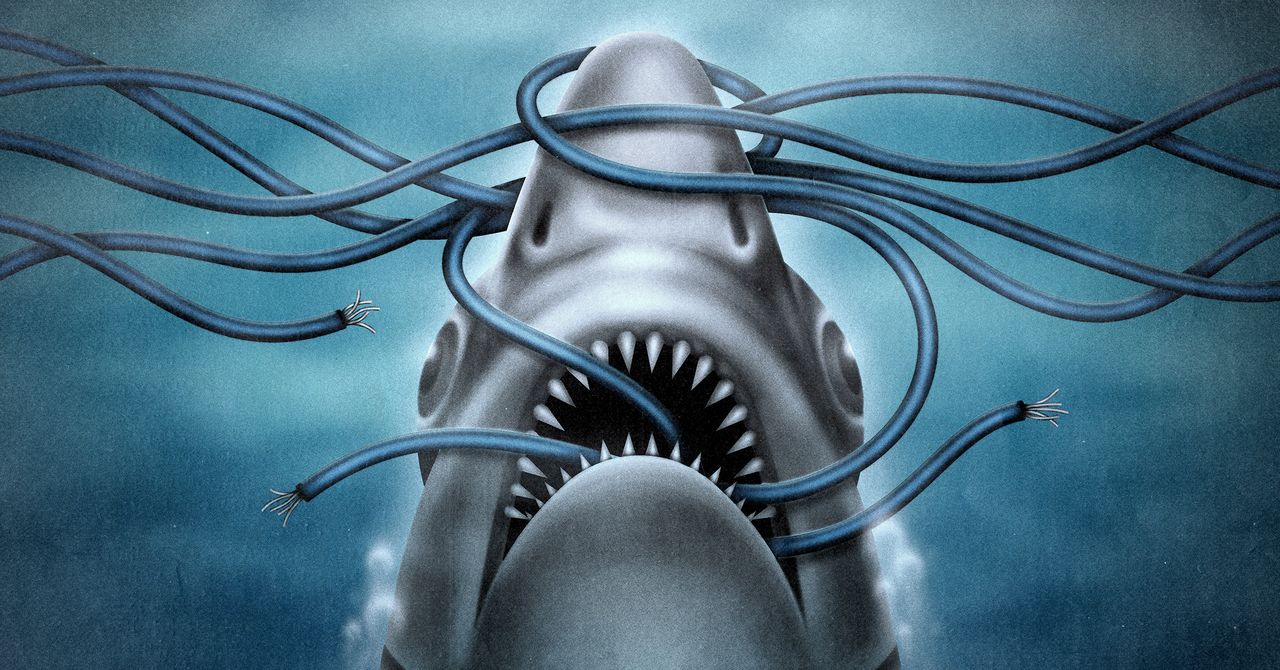
Sharks are innocent. Or, at the very least, they aren’t gnawing through your internet connection.
We love the myth, though. It feels almost poetic that prehistoric apex predators might be chewing on the glowing glass veins of our hyper-connected world — as if nature were staging a slow, toothy rebellion against our relentless digital sprawl. But they aren’t. According to WIRED, the real story of our underwater networks isn’t about animal sabotage or covert espionage. It’s about something far more grounded.
It’s about the sweaty, unglamorous, highly specialized human labor required to drag the obsolete internet out of the ocean.
The “Cloud” Has a Weight Problem
Most of us never stop to consider the physical mass of digital space. We talk about “the cloud” as if our data drifts magically in the stratosphere. It doesn’t.
Our entire modern existence — every transatlantic Zoom call, every high-frequency financial trade, every bleary-eyed 3 AM doomscroll — is piped through garden-hose-thick tubes resting in the freezing silt of the seabed. And that hidden infrastructure is getting extraordinarily congested.
TeleGeography estimates that well over 1.4 million kilometers of active submarine cables currently encircle the globe. That figure doesn’t even account for the dead ones. Fold in the retired cables abandoned by telecom giants and you’re looking at close to 2 million kilometers of industrial debris quietly cluttering the ocean floor — a graveyard nobody visits.
Rats, surprisingly, pose a far bigger threat to terrestrial cables than sharks ever have to oceanic ones. Their incisors never stop growing, so they gnaw on semi-soft casings to file them down. Nobody asks about the rats, though. As a recovery engineer recently joked, sharks make you sound cool and dangerous. Rats just make it sound like you have a pest control problem.
The Sliver of Glass That Compressed the Planet
If you want to pinpoint the exact moment the modern world snapped into focus, circle December 14, 1988, on your calendar. That was the day TAT-8 went live.
Assembled by a coalition of AT&T, British Telecom, and France Telecom, TAT-8 was the eighth transoceanic telephone system across the Atlantic — but the absolute first to transmit data via optical fiber. Before this, global communication crawled through heavy, inefficient copper wire. Using fiber optics to span continents in the late 1980s was, in practical terms, about as audacious as human beings deciding to colonize another solar system.
Voice and data were converted into pulses of light, threaded across spiderweb-thin strings of glass, and reassembled into sound on the other side. The concept was so disorienting that Alec Reeves — the English scientist instrumental in developing fiber-optic transmission — also spent considerable time researching psychokinesis and telepathy. Honestly? There isn’t a massive conceptual gap between turning a voice into a transatlantic beam of light and attempting to move a pencil with your mind. Both demand a fundamental conviction that the physical boundaries of reality are negotiable.
A Front-Row Seat to History
When TAT-8 was switched on, science fiction legend Isaac Asimov christened it via video link from New York to Paris and London. “Welcome everyone to this historic transatlantic crossing,” he said. “This maiden voyage across the sea on a beam of light.”
AT&T ran earnest television spots promising a “worldwide intelligent network.” They didn’t sell it on the promise of the internet — which was still a fringe academic curiosity — but on the raw, emotional pull of connecting a fractured world at the Cold War’s twilight.
And TAT-8 witnessed all of it.
It carried the data of the Berlin Wall’s fall. The Soviet Union’s implosion. The chaotic, brilliant birth of the World Wide Web. The dot-com delirium, the devastation of September 11, the stumbling dawn of early social media. Planners originally assumed this single cable would shoulder global capacity for years. Instead, humanity’s appetite for connection proved so ferocious that it maxed out in just 18 months. By 2002 — having developed faults that were simply too expensive to remedy — TAT-8 was quietly decommissioned. Left to sleep in the dark at the bottom of the Atlantic.
There’s Serious Money in Dead Cables
For decades, telecom companies simply abandoned their dead infrastructure down there. Out of sight, out of mind.
The seabed, though, is practically a rush-hour corridor now. Space along the safest, flattest underwater ridges commands a premium. You cannot keep laying new glass on top of old glass indefinitely — at some point, the math stops working.
Enter the scavengers.
“Billions of people are able to walk around not noticing this infrastructure because of the daily work of a few thousand people, sometimes at sea, other times buried under piles of permits.”
— Offshore operations field notes
Operations like Subsea Environmental Services have turned the retrieval of dead cables into a highly specialized, surprisingly lucrative trade. They are one of only three outfits globally that treat cable recycling as their entire business model — not a side project, not an afterthought. They clear proven, efficient routes so new networks can be threaded without disturbing untouched sections of the seafloor. And there is serious money in aged copper, steel, and polyethylene, if you know how to process it correctly.
It’s an intricate, hazardous operation. Take the MV Maasvliet — a diesel-electric recovery vessel that left drydock in January 2025 and has been running operations for over a year now, powered by three massive industrial Volvo truck engines. When actually out on deployment, the ship and its crew spend weeks dodging early hurricane seasons to haul up thousands of kilometers of wire at a stretch. The hands-on reality is unglamorous in ways that no press release would ever admit.
When they dock at ports like Leixões in Portugal, the collective exhale is almost audible. Captains trade off command. Captain Vlad — stepping in for his rotation — is known to arrive wearing a t-shirt that reads “Everything can go wrong at sea” on the front, and “Not on my fucking watch!” on the back. The man has a brand.
Ask anyone who has spent real time offshore, though, and they’ll tell you the most indispensable person on board isn’t the captain. It’s the cook.
The Maasvliet’s crew is a cross-section of Ukrainians, Russians, Poles, Nigerians, and Kenyans — a genuinely unlikely village assembled at sea. The isolation grinds people down in ways that don’t show up in the operational logs. So the cook learns everyone’s comfort foods, quietly, as a form of preventive maintenance for crew morale. When one crew member casually mentioned missing khinkali — Georgian soup dumplings — they materialized on the mess table the following Sunday. That kind of detail doesn’t make it into any corporate sustainability report, but it’s probably what keeps the whole operation from unraveling.
We’ve Forgotten the Internet Has a Body
Here is where the perspective needs to shift. As of early 2026, we are collectively consumed by the promises of artificial intelligence, spatial computing, and hyper-automation — and in the process, we’ve grown dangerously detached from the physical reality underpinning all of it.
We treat connectivity as an atmospheric right. A utility that simply exists, like oxygen.
What would actually happen if those underwater threads were severed? A Pew Research analysis on digital life consistently underscores just how completely reliant our global economic architecture is on uninterrupted connectivity. Entire nations would financially seize within days. And yet the people keeping the lights on — the ones eating soup dumplings on storm-tossed vessels in the North Atlantic — remain entirely invisible to the billions of people whose lives depend on their work.
Is that invisibility accidental, or is it convenient?
It’s genuinely galling when tech executives casually remark that consumers “only notice IT infrastructure when it breaks.” That framing assumes the infrastructure simply exists on its own, self-sustaining and frictionless. It doesn’t. Someone built it. Someone is, right now, pulling it back out of the ocean.
Recycling the internet is going to become one of the defining logistical headaches of the next decade. The Global E-waste Monitor has flagged the escalating urgency of recovering raw materials from discarded technology — and subsea cables are essentially the largest, most inaccessible veins of e-waste on the planet. The scale is hard to fully absorb.
Hauling up TAT-8 isn’t merely a maritime cleanup operation. It’s a symbolic closing of a chapter — arguably one of the most consequential chapters in the history of human communication. The very cable that practically conjured the concept of instantaneous global connectivity is currently being chopped into sections, sorted by material, and fed into a smelter. Scrap.
Humbling, really. The grandest technological achievements of one generation reliably become the raw materials of the next. And the sharks? Still down there. Still completely indifferent to the whole thing.
Reporting draws from multiple verified sources. The editorial angle and commentary are our own.