As of early 2026, tech reviewers are finally reckoning with a ridiculous problem we’ve all quietly swallowed for a decade. Our wrists are astonishingly smart. Our charging habits are embarrassingly primitive.
Think about your pockets right now. Phone, keys, maybe a wallet if you haven’t fully digitized your life yet. Toss in some AirPods. Wrap an Apple Watch Ultra 3 around your wrist. That’s a staggering digital load to haul through a single Tuesday. Every one of those devices needs juice — constantly, urgently, without mercy. We spend our days managing miniature power grids, doing anxious mental math about percentages and commute times and whether that meeting room has an outlet near the door.
You know the feeling. That slight tightening in your chest when the watch buzzes with a 10% warning and you’re miles from home, hours left in your day, charger sitting uselessly on the nightstand like a forgotten promise.
The dread is real. Per Pew Research Center tracking, the vast majority of adults now treat their smartphone as an essential lifeline — and that fierce psychological dependency has trickled steadily down to our wearables. When the watch dies, we lose navigation, health tracking, quick-glance communication. We become, in the most modern sense of the word, untethered.
Your Phone Is Already a Battery Pack — You’re Just Not Using It That Way
We hit peak battery capacity a while ago. There’s only so much lithium-ion chemistry you can wedge into a device the size of a cracker before physics plants its flag and refuses to negotiate.
So the answer isn’t bigger batteries. It’s parasitic power.
“We hit the physical limits of wearable battery tech years ago. The real innovation now lies entirely in how seamlessly we can distribute power between the devices we already carry.”
Dr. Elena Rostova, Energy Systems Researcher
When Apple finally yielded to European regulatory pressure and slapped a USB-C port on the iPhone 15 back in 2023, most of us just cheered because we could finally bin our Lightning cables. We missed the larger implication entirely. That port quietly converted the iPhone into a pocket-sized power bank — a massive battery that happens to scroll Instagram and occasionally make phone calls.
For years, though, we barely leaned on this capability. Why? Because hauling a three-foot white cable around on the off-chance your watch dips into the red is genuinely miserable. Cords tangle. They collect grime. They belong coiled in backpack pockets, not rattling loose in your jeans.
The Invisible Weight We Carry Every Single Day
There’s a particular kind of low-grade exhaustion that comes from managing your devices’ hunger. Not the dramatic, obvious stress of a dead phone before a flight — something quieter and more chronic. A background hum of vigilance. Checking percentages the way anxious people check door locks.
The tech industry spent years framing this as a solved problem. Bigger batteries! Faster charging! Wireless pads on every desk! And yet, in practice, the friction never disappeared — it just relocated. From the wall outlet to the charging mat. From the mat to the travel adapter. From the adapter to the frayed cable you swore you’d replace three months ago.
What nobody seriously addressed was the gap between home infrastructure and the real world. Out there — on trails, in airport terminals, across conference rooms — you’re on your own.
Keys, Wallet, Phone… and a Charging Puck That Changes the Arithmetic
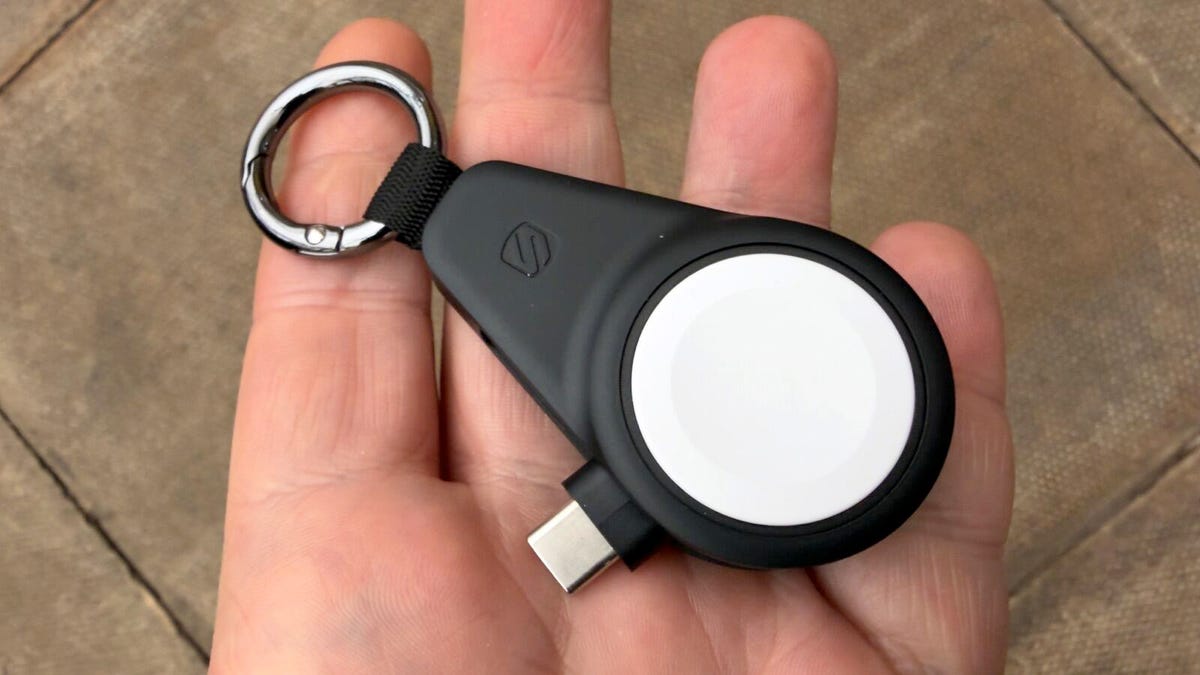
Which brings us to a small piece of white polymer that quietly reshuffles the daily carry equation: the Scosche WatchIt.
Magnetic fast charger for Apple Watch and AirPods, compressed to the footprint of a keychain fob. But the ingenuity isn’t the size — it’s the mechanism. Rather than a cord, the puck sports a flip-out USB-C connector that swivels cleanly on a hinge. Pop it open, plug it directly into the base of your iPhone or iPad, snap your watch onto the magnet. Done. Power moves from phone to wrist without a single loose cable entering the picture.
My Apple Watch Ultra 3 has anchored my daily carry for the better part of a year. Hundreds of logged hiking miles. A deliberate escape hatch from the infinite scroll of my phone screen. But when camping or traveling, keeping it alive once meant packing Apple’s proprietary charging wire — one more thing to lose, forget, or leave threaded through the wrong bag pocket.
Now? I reach for my keys.
The physical design of the WatchIt reflects a rare, almost anthropological understanding of how people actually move through the world. Keys are essentially pocket sandpaper — they gouge plastics, scratch screens, and destroy anything fragile that dares share the same denim real estate. Scosche built this puck from tough polymers engineered specifically to shrug off abrasion. The swivel hinge lets you tuck the USB-C connector flush when it’s not in use, blocking the port from filling with the lint and grit that quietly killed so many older portable accessories.
A sturdy spring keyring threads through a short loop of nylon webbing — the kind of webbing that feels like it could survive a decade of abuse without developing an opinion about it. Clip it to a hiking pack’s shoulder strap or let it rattle alongside your house keys. Either way, you’re not babying it.
Why Paying More for Less Cable Actually Makes Sense
Convenience, as ever, carries a premium.
The Scosche WatchIt retails for $35. Apple’s official magnetic charging cable sits at $25. On the surface, paying ten dollars more for a device with no cord attached feels perverse — more money, less material. A reasonable person might balk.
That assumption, though, ignores how cables actually behave in the wild. Transient. Perpetually misplaced. Left coiled into hotel room outlets across three continents. Lent to colleagues and never seen again. Frayed at the neck until copper wire pokes through the insulation like a hazard. A keychain accessory operates under an entirely different logic — it’s anchored to the one object you physically cannot walk out the door without. Permanence, it turns out, has a street value.
And it doesn’t shortchange performance to get there. The WatchIt is rated to deliver 4W — which, when tested in practice, matches Apple’s own fast-charging ceiling for the Watch, making it genuinely useful for rapid top-ups at a coffee shop table or mid-hike on a trailside boulder.
Scale matters here, too. According to data from Counterpoint Research, Apple commands a dominant slice of the global smartwatch market — which means millions of people are grinding through this exact charging friction every single day, whether they’ve named the frustration or not.
The Closed Loop: When Your Devices Start Feeding Each Other
Using the WatchIt in the field feels less like a product demo and more like a small systems revelation. It forges a closed-loop ecosystem from the tech trifecta — iPhone, Watch, AirPods — where the largest battery quietly nourishes the smaller ones. The phone becomes infrastructure, not just a device.
Practically speaking? The dedicated Apple Watch dock has been gathering dust on my nightstand for months. Docks are nightstand furniture. Out in the actual world — moving, traveling, existing somewhere other than your bedroom — they’re dead weight. Every ounce on a long trip is a small tax; every tangled cable in a bag is a small erosion of patience, compounding across days.
The industry spent a solid decade peddling the idea that we needed specialized charging mats, branded stands, and proprietary bricks for every gadget in the rotation. The USB Implementers Forum specifications eventually unified the physical port — a genuinely hard-won standardization, per the organization’s own documentation — but it took accessory makers several more years to fully exploit the freedom that single shared port unlocked.
Is it a perfect system? Not quite — you’re still drawing down your phone’s charge, which matters on a 14-hour travel day when every percentage point feels precious. But the hands-on reality is that the math almost always works in your favor. An iPhone carries enough capacity that nudging your watch from 10% to 60% barely registers on the phone’s battery gauge. The exchange rate is wildly favorable.
Slowly, stubbornly, we’re breaking free from the wall outlet. The power source was already in your pocket. You just needed the right key to reach it.
Will the Scosche WatchIt fit if my iPhone has a thick protective case?
Yes. The engineers deliberately elongated the USB-C connector so it can reach deep ports without drama. Even wrapped in a heavy-duty case, the swivel mechanism lets it snap securely into place — no need to strip your phone naked first.
Does this drain the iPhone battery too quickly?
Not noticeably. The battery capacity gap between an iPhone and an Apple Watch is enormous — transferring enough power to bring your watch from 10% to 50% will barely register as a blip on your phone’s overall charge level.
Can I use it with older iPhones?
You need a USB-C port, which for iPhones means the iPhone 15 series or anything newer. That said, the WatchIt also works plugged into any modern iPad, MacBook, or Android phone with reverse charging capabilities — making it more versatile than it first appears.
Based on reporting from various media outlets. Any editorial opinion is that of the author.