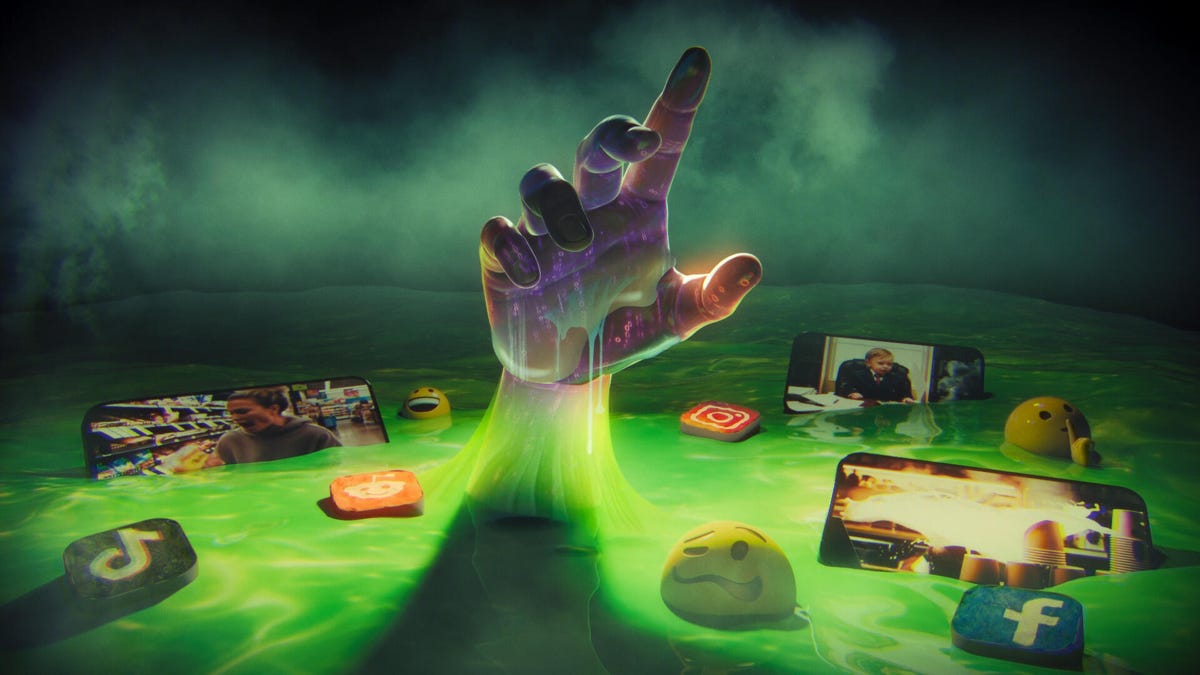
I was scrolling through my feed the other night, and for a second, I genuinely thought I’d lost my mind. You know that feeling? When you’re half-asleep and your thumb is just doing the work for you? I saw a video of a golden retriever playing a grand piano made of—I kid you not—sausages. It was followed immediately by one of those “satisfying” clips where someone was spreading what looked like neon-blue gravel onto a piece of sourdough. It wasn’t just weird; it was hollow. It felt like looking at a dream described by someone who has never actually been awake. This is the reality of the internet in 2026: we aren’t just browsing anymore; we’re living in a massive digital oil spill.
Now, get this: according to CNET, the vast majority of US adults—about 94%—believe they are constantly bumping into AI-generated content while they scroll. But here’s the real kicker: only 11% of them actually find any of it useful or entertaining. That’s a staggering gap. We’re being force-fed a diet of “slop,” a term that has become the catch-all for the lukewarm, plastic-looking, and often nonsensical output of generative models that have been allowed to run wild across our social platforms. It’s the digital equivalent of mystery meat, and we’re all being asked to take a bite.
But while most of us just sigh, roll our eyes, and keep scrolling, some people are actually rolling up their sleeves to fight back. Take Rosanna Pansino, for instance. If you’ve spent any time in the baking corner of the internet over the last fifteen years, you know her. You probably remember her Death Star cakes or those holographic chocolate bars that went viral back in the day. She’s a veteran. Now, she’s pivoted her creative energy toward a new, slightly more aggressive mission: “Kicking AI’s butt.” And honestly? It’s the most refreshing thing I’ve seen on the internet in months. It’s a reminder that human effort still counts for something in a world of instant prompts.
Why Does Everything Look Like It Was Rendered in a Haunted Plastic Factory?
We’ve all seen it. That slick, slightly-too-shiny veneer that covers AI-generated images. It’s that “uncanny valley” look that makes your skin crawl just a little bit. The hands with six fingers (though they’re getting better at that, unfortunately), the physics that don’t quite make sense, and the bizarre “brainrot” videos that seem designed to hold your attention without actually providing a single second of value. It’s content for the sake of content, produced at a scale that human creators simply can’t match. It’s like the algorithm found a way to bypass our brains and go straight for our dopamine receptors using nothing but bright colors and nonsensical movement.
The problem is that AI makes creation too easy. When you can generate a video with a few clicks using tools like OpenAI’s Sora or Google’s Nano Banana, the barrier to entry vanishes. But when the barrier to entry vanishes, so does the soul. We’re seeing a flood of “unlikely objects on toast” or fake animals doing impossible things. It’s harmless fun until you realize it’s crowding out the actual humans who spent years honing their craft. Why spend twenty hours learning to animate a cat when a bot can spit out a “hyper-realistic” feline tower in thirty seconds? It’s a race to the bottom, and the winner is whoever can flood the zone with the most noise.
Pansino decided to tackle this head-on by recreating these “slop” videos in real life. She took a viral AI clip of sour gummy peach rings being smeared on toast—a feat that looks easy in a simulated world but is a nightmare in a kitchen. Think about that for a second. Have you ever tried to smear a gummy bear? It doesn’t work. She had to infuse butter with peach oil, mold it into rings, freeze them, and then coat them in citric acid and sugar just to mimic the “look” of the AI video. It was a painstaking, multi-hour process that highlighted exactly what AI lacks: effort, intent, and the physical reality of being alive. It was a statement: “I can do this, but it takes actual work.”
“Human creativity is one of the most important things we have in the world. And if AI drowns that out, what do we have left?”
— Rosanna Pansino
Follow the Money: Why the Internet Is Turning Into a Digital Landfill
You might wonder why platforms allow this. If only 11% of people like this stuff, why is it everywhere? The answer, as always, is money and metrics. It is significantly cheaper to flood a platform with 10,000 AI-generated “satisfying” clips than it is to nurture and pay one human creator who takes a week to produce a single high-quality video. The algorithms don’t necessarily care if you love the content; they care if you look at it. They care about retention time, not quality of experience. If a video of a fake bunny on a trampoline keeps you on the app for ten seconds longer, the algorithm considers that a win.
And boy, are we looking. A report from Kapwing recently found that if you were to sign up for a new YouTube account today, a staggering one-third of the first 500 Shorts shown to you would be some form of AI slop. It’s baked into the experience. It’s the microplastics of the digital age—invisible until you realize it’s in everything you consume. By February 2026, TikTok already had over 1.3 billion videos labeled as AI-generated, and that’s just the stuff people are actually admitting to. Think about the millions of other videos that are flying under the radar, pretending to be real.
This isn’t just a “vibe” shift; it’s a fundamental change in how information moves. It feels like we’re losing the “human” part of the internet. A 2024 Pew Research Center study found that about 52% of Americans are more concerned than excited about the growing role of AI in daily life. That concern is manifesting as “slop fatigue.” We’re tired of the fake bunnies on trampolines. We’re tired of AI Overviews telling us to put glue on our pizza to keep the cheese from sliding off—yes, that actually happened. We’re tired of the internet feeling like a ghost town populated by bots talking to other bots while we just watch from the sidelines.
Channeling Our Inner Dwight Schrute to Outrun the Automation Age
Pansino’s approach reminds me of that classic episode of The Office where Dwight tries to outsell the company’s new website. It’s Man vs. Machine in its purest, most absurd form. It’s about proving that the human touch still has a competitive edge. “Dwight, single-handedly, is outselling the website,” Pansino noted. “That’s what I feel like when I’m baking against AI. It’s a nice rush.”
There’s something deeply human about that “rush.” It’s the refusal to be automated. It’s the stubbornness of saying, “I’m still here, and I’m still better at this.” When she successfully smeared those handmade butter rings onto toast, she wasn’t just making a snack; she was proving that reality still has a weight that pixels don’t. She was reclaiming the “satisfying” genre from the algorithms and giving it back to the people who actually know how to use a silicone mold. It’s a small victory, sure, but in 2026, we’ll take what we can get.
But we can’t expect every creator to spend forty hours recreating a five-second AI clip just to prove a point. That’s not sustainable. The cleanup of this “oil spill” requires more than just individual acts of defiance. It requires a systemic shift in how we build and interact with these platforms. We’re starting to see the beginnings of this—creators pushing for better labeling, developers building “AI-free” havens, and researchers testing ways to keep hallucinations from gaining the status of “fact.” It’s going to be a long fight, but it’s one worth having.
Is There a Way Out of This, or Are We Just Living in the Ghost of the Internet?
I don’t think we’ll ever be completely rid of AI content. It’s too late for that. The toothpaste is out of the tube, and the tube has been crushed by a robot. AI is here to stay, and in many ways, it’s useful. But what we can do is change how we value what we see. We’re moving toward a world where “Human-Made” might become the most important luxury label on the internet. We might start seeking out the flaws, the shaky camera work, and the slightly burnt edges, because those are the things a prompt can’t quite replicate.
The internet was built on the back of weird, human moments. Charlie Bit My Finger, Grumpy Cat, the Evolution of Dance—these weren’t polished, and they certainly weren’t “optimized” for an algorithm. They were just people being people, sharing something real with the world. If we lose that to a sea of “Feel the AGI” memes and AI-generated feline towers, we lose the very thing that made the internet worth visiting in the first place. We lose the connection.
What exactly is “AI Slop”?
In short? It’s the junk mail of the social media era. AI Slop refers to low-quality, often nonsensical or repetitive content generated by AI models. It includes everything from “brainrot” social media videos to AI-generated articles filled with hallucinations and fake facts. It is characterized by a lack of human intent and a “slick” but hollow aesthetic that feels more like a product than a creation.
How can I identify AI-generated content?
While models are getting better, you can usually spot the “plastic veneer.” Look for images that look too smooth, skin that has no pores, or lighting that doesn’t seem to have a clear source. In videos, watch for objects that morph into other things—like a spoon becoming a finger—or characters that don’t follow the laws of physics. Many platforms are also now required to use labels like “Generated by AI,” though these are often hidden or ignored.
Why is AI slop considered harmful?
It’s more than just an eyesore. Beyond being annoying, it drowns out human creators who can’t compete with the speed of a bot. It also spreads misinformation (like that infamous “glue on pizza” advice from Google’s AI) and consumes massive amounts of energy. Perhaps most interestingly, it creates a “feedback loop” where AI models are trained on other AI slop, leading to a degradation in the quality of the models themselves over time. It’s essentially digital inbreeding.
Final Thoughts: Choosing Reality Over the Prompt
At the end of the day, the fight against AI slop isn’t about being anti-technology. I love technology. It’s about being pro-human. It’s about recognizing that a video of a real person struggling to make a peach-ring cake—messing up, trying again, and finally succeeding—is infinitely more valuable than a thousand perfectly rendered AI clips of the same thing. One has a story; the other just has a prompt. One is an experience; the other is just data.
We’re at a crossroads. We can either accept a digital world that is “good enough” and cheap to produce, or we can demand a world that is messy, difficult, and undeniably real. I’ll take the peach-flavored butter rings over the pixels any day. After all, you can’t actually eat a prompt, and you certainly can’t build a community around one.
This article is sourced from various news outlets. Analysis and presentation represent our editorial perspective.