Let’s be honest: the party is officially over, and if you ask me, we should all be breathing a massive sigh of relief. If you’d walked into any high-end Jakarta coffee shop three or four years ago, the atmosphere was unmistakable. It was thick with the smell of expensive Arabica, sure, but it was also heavy with that frantic, almost desperate energy of “growth at all costs.” It was a wild, dizzying time where pitch decks were written on napkins and “burn rates” were worn like badges of honor. But standing here in the early months of 2026, the vibe has fundamentally shifted. It’s quieter, more focused, and infinitely more grounded. According to the latest insights from RISE by DailySocial, the Indonesian tech ecosystem has finally survived its awkward, impulsive teenage years. We’ve moved into a phase of gritty, sustainable maturity. We aren’t just talking about burning through millions of dollars in venture capital to “buy” market share anymore; we’re finally talking about actual, honest-to-goodness margins and business models that don’t collapse the moment the funding stops.
It’s been a long, often painful road to get to this point. We all remember the “Startup Winter” that began back in 2022. At the time, it felt like a permafrost that would never lift, a period of layoffs and shuttered offices that left everyone questioning the future of the region’s digital economy. But looking back from our current vantage point in February 2026, it’s clear that the frost was exactly what this garden needed. It killed off the weeds—those companies that only existed because capital was cheap, interest rates were near zero, and due diligence was treated as an optional formality. What’s left in the wake of that chill is a leaner, meaner, and frankly, much more interesting landscape. We’re seeing a generation of companies that don’t just know how to spend money, but actually know how to make it.
I was catching up with a founder friend the other day—someone who’s been in the trenches since the early 2010s. He told me that the absolute best thing that ever happened to his fintech firm was getting rejected by ten different VCs back in 2024. At the time, he was devastated. But that string of “no’s” forced his team to stop chasing “vanity metrics”—you know, the kind of user growth numbers that look great on a slide but mean nothing for the bottom line—and start looking at their unit economics with a magnifying glass. And guess what? They’re profitable today. They aren’t just surviving; they’re thriving on their own terms. That, in a nutshell, is the story of the 2026 Indonesian tech scene. The obsession with “unicorn” status has faded, replaced by a deep respect for “cockroach” resilience—the kind of businesses that are built to survive anything the market throws at them.
“The era of the ‘blitzscaling’ fantasy has been replaced by the reality of the ‘profitability’ mandate. Investors are no longer buying dreams; they are buying cash flow.”
Senior Partner at a leading SE Asian Venture Firm, January 2026
The receipts: A decade of transformation written in the data
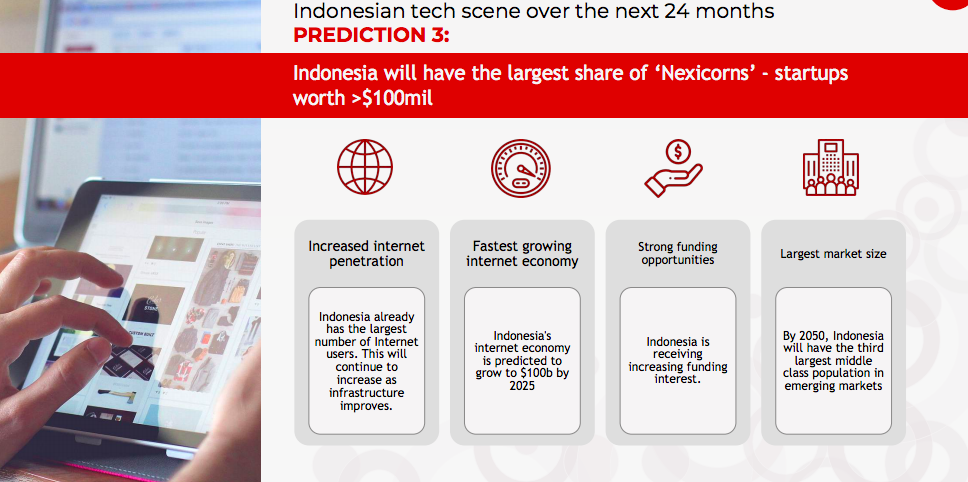
To really get a handle on how far we’ve come, you have to look past the anecdotes and dive into the numbers. They tell a story of a region that has moved from “potential” to “powerhouse.” A 2025 report by Google, Temasek, and Bain & Co. confirmed what many of us felt on the ground: Southeast Asia’s digital economy has officially surged past the $300 billion mark in Gross Merchandise Value (GMV). What’s even more impressive? Indonesia is responsible for nearly 40% of that entire total. That isn’t just a big, shiny number for a headline; it’s a testament to how deeply digital services have woven themselves into the fabric of everyday life. We aren’t just talking about kids in Jakarta anymore. We’re talking about small business owners in Medan and families in Merauke who are now fully integrated into the digital fold.
But the real kicker—the thing that really proves the “reset” is working—is the massive shift in where the money is actually going. According to Statista, by the end of 2025, more than 60% of late-stage funding rounds in Indonesia were funneled toward companies that had already achieved EBITDA positivity or could show a bulletproof path to reaching it within a year. Think about that for a second. Compare that to 2021, when that figure was barely scraping 15%. The market has stopped rewarding the “burn” and started rewarding the “build.” It’s a fundamental, and very welcome, shift in the DNA of the region’s capital markets. We’ve traded the sugar high of venture debt for the steady energy of real revenue.
And then there are the IPOs. I don’t think we talk enough about how much the exit landscape has matured. In 2025, we saw a record number of local tech companies listing on the Indonesia Stock Exchange (IDX). No, they weren’t all billion-dollar, earth-shaking blockbusters, but they were solid, mid-cap companies with real books and real customers. These listings gave early-stage investors a much-needed exit path and, perhaps more importantly, gave retail investors in Indonesia a chance to actually own a piece of the digital economy. It’s a far healthier environment than the one we saw during the 2021-2022 frenzy, where everyone was holding their breath for a massive US SPAC deal that, in most cases, never actually materialized. We’ve learned to build for our own backyard first.
Why the “Human Element” is the new secret sauce
For the longest time, there was this prevailing wisdom that the winner in the tech space would simply be whoever had the smartest algorithm or the deepest pockets. But as we move through 2026, that theory has been thoroughly debunked. The real winners—the ones who are actually sticking around—are the ones who understand local nuance better than anyone else. It’s exactly why regional players are consistently outmaneuvering global giants. They realize that a user in a second-tier city in Central Java has a completely different set of needs, constraints, and behaviors than someone living in Singapore or San Francisco. You can’t just copy-paste a business model from Silicon Valley and expect it to work in the archipelago.
The “hyper-local” approach has moved from being a trendy buzzword to a basic survival strategy. We’re seeing AI being deployed in incredibly practical ways—not just for flashy, generic chatbots, but for localizing credit scoring for unbanked farmers who have never stepped foot inside a traditional bank. We’re seeing logistics startups that have finally cracked the code of the “last mile” in a country comprised of over 17,000 islands. This isn’t tech for tech’s sake. This is tech being used as a tool to solve the actual, physical bottlenecks that have held back Indonesia’s economic growth for decades. It’s pragmatic, it’s difficult, and it’s working.
I think we often overlook the sheer amount of “grit” required to build a business in this part of the world. Yes, the infrastructure is improving every day, but it’s still a notoriously challenging environment. The founders who have managed to survive the last four years are, in my opinion, some of the most battle-hardened entrepreneurs on the planet. They’ve had to navigate wild currency fluctuations, sudden regulatory shifts, and a global pandemic—all while trying to build something from nothing. If one of these founders tells me they’ve found a way to turn a profit in the current climate, I’m inclined to believe them. They’ve earned that credibility the hard way.
The Elephant in the Room: Is the “Green” Transition for real?
Of course, we can’t have a serious conversation about the 2026 economy without tackling the issue of sustainability. There’s been an incredible amount of noise about Indonesia’s potential to become a global “EV Battery Hub.” And on the surface, the numbers are staggering—the government’s downstreaming policy for nickel has successfully pulled in billions of dollars in foreign direct investment. But as an analyst looking at the long-term picture, I have to ask: what is the true cost of this progress? We’re seeing these massive industrial parks spring up in places like Sulawesi and Maluku, and while they are indeed powering the global electric vehicle revolution, the local environmental impact is something we’re only just starting to truly reckon with.
It’s a complicated situation. According to a 2025 report by the International Energy Agency (IEA), Indonesia is now the world’s undisputed leader in nickel production, and it’s not even close. However, the carbon intensity of that production remains significantly higher than the global average. Why? Because we’re still largely relying on coal-fired power plants to run the smelters. It’s one of the great ironies of our current era: we are literally burning coal to produce the batteries that are supposed to “save” the planet from fossil fuels. It’s a paradox that we can’t afford to ignore if we want this growth to be truly sustainable in the decades to come.
But it’s not all doom and gloom. There’s a new wave of “Climate Tech” startups emerging in Jakarta and beyond that give me a lot of hope. These companies aren’t focusing on flashy headlines; they’re working on the unglamorous but essential stuff—circular economy solutions, better waste management systems, and ways to integrate renewable energy into the existing grid. They’re relatively small players right now, but they represent the next great frontier. If the last decade was defined by the “Digital Transformation,” I’m convinced the next one will be defined by the “Green Decoupling.” We have to figure out how to continue our economic ascent without destroying the very islands and ecosystems we call home.
Is it still a good time to invest in Indonesian startups?
In short: absolutely. But the playbook has changed completely. If you’re looking for a quick flip based on hype, you’re about three years too late. In 2026, smart investors are hunting for “Value.” If a company has a defensible moat, a clear and proven path to profitability, and a management team that actually understands the ground-level reality of the Indonesian market, it’s a fantastic time to get in. Valuations have come down to earth and are much more realistic now than they were during the bubble years of 2021.
Which sectors are actually leading the charge in 2026?
Fintech is still the heavyweight champion, particularly in areas like specialized credit and insurance tech where there’s still massive under-penetration. However, the real growth stories are happening in Agritech and Healthtech. As digital infrastructure finally reaches the more rural and remote parts of the country, these sectors are exploding. Also, keep a very close eye on Climate Tech—it’s the “one to watch” for the back half of this decade as the pressure to decarbonize intensifies.
Looking ahead: The decade of the “Pragmatic Optimist”
As we head further into 2026, the overall mood in the Indonesian tech sector is one of “pragmatic optimism.” We’ve stopped making those wild, baseless predictions that used to dominate every conference panel. We know that growth is hard work. We know that the global economy is still a bit of a rollercoaster and that external shocks are always a possibility. But we also know that the underlying fundamentals of Indonesia—the young, tech-savvy population, the rapidly expanding middle class, and the wealth of natural resources—haven’t gone anywhere. The potential is still there; it’s just being channeled more effectively now.
The big difference today is that we’re building on a foundation of reality rather than a foundation of cheap debt and wishful thinking. The companies that are thriving in 2026 are the ones that treated their customers with respect, kept a hawk-like eye on their margins, and—most importantly—didn’t start believing their own hype. It might be a “boring” way to build a billion-dollar company compared to the old blitzscaling days, but it’s the only way that actually works when the honeymoon period ends. It turns out that sound business principles are never actually out of style.
And honestly? I much prefer it this way. It’s incredibly refreshing to go to a tech event and hear people debating “customer acquisition cost” and “lifetime value” instead of talking about “web3 metaverses” or the latest “NFT drop.” We’ve returned to the basics of what makes a business work, and in doing so, we’ve built something far more durable and resilient. Indonesia isn’t just the “next big thing” on a VC’s map anymore. It is the current big thing. It’s a mature, functioning market that has survived its trial by fire, and I truly believe we’re just getting started on the next, more sustainable chapter.
This article is sourced from various news outlets. Analysis and presentation represent our editorial perspective.