Let’s be honest for a second: until quite recently, the idea of a “smart home” felt like a playground for Silicon Valley tech bros or people with way too much disposable income. You’d imagine voice-activated curtains and refrigerators that talk back to you, usually with a price tag that made your eyes water. But something shifted during those long months we all spent staring at our own four walls during the pandemic. According to Hybrid.co.id, the conversation has moved away from high-end luxury toward practical, everyday efficiency. We’ve finally realized that home appliances aren’t just tools; they’re the infrastructure of our sanity—especially when your living room is also your office, gym, and cinema.
Xiaomi has been at the absolute forefront of this shift, and it’s not just because they make things “cheap.” It’s because they’ve figured out the secret sauce of the modern consumer: we want gadgets that look like they belong in a Muji catalog but work like they were designed by NASA, all for the price of a decent dinner out. They’ve turned “smart living” from a high-end aspiration into a weekend impulse buy. And honestly? It’s about time someone did.
Why we finally stopped pretending to enjoy sweeping
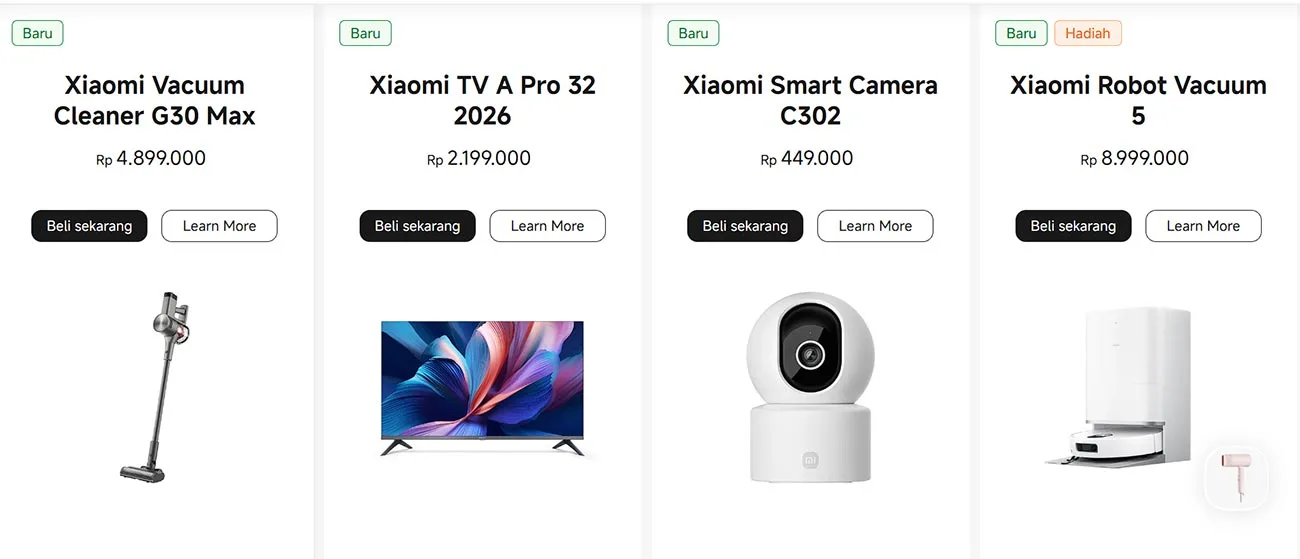
There was a time when buying a vacuum cleaner was a major life event. You’d save up, do your research, and end up with a bulky, loud machine that lived in the back of a closet. Xiaomi changed that narrative by making the vacuum an active—almost sentient—participant in the household. When you look at the Xiaomi Vacuum Cleaner P30 or the G20 Lite, you aren’t just looking at suction power; you’re looking at the democratization of leisure time. Why spend forty minutes sweeping and mopping—badly, I might add—when a Robot Vacuum like the E5 or the S40 Pro can do it while you’re catching up on emails or, let’s be real, doom-scrolling on your phone?
But here’s the real editorial take: the genius isn’t the hardware, it’s the psychological relief. There is a specific kind of “adulting” stress that comes from seeing dust bunnies under the sofa. By pricing these units at the “one million rupiah-ish” mark, Xiaomi has removed the guilt of outsourcing chores. It’s no longer a luxury to have a robot mop your floors; it’s a tactical decision for your mental health. We’re seeing a shift where “clean” is no longer a verb you perform, but a state of being maintained by your ecosystem.
And it doesn’t stop at floors. The versatility of the G20 Lite, which tackles everything from mattresses to those impossible-to-reach corners of the sofa, acknowledges that our homes are multi-dimensional. We don’t just live on the floor; we live on the couch, the bed, and the carpet. Xiaomi’s strategy seems to be: find the friction in a human’s day and build a sleek, white plastic solution for it.
Clean air shouldn’t be a luxury, and we’ve finally realized it
If you live in a major city, you know the “invisible” weight of the air. We used to think air purifiers were for people with severe allergies or those living next to factories. Now, they’re becoming as standard as a microwave. Xiaomi’s Smart Air Purifier 4 Lite and its beefier siblings like the 4 Pro or the Mijia Smart Air Purifier 6 have tapped into a growing collective anxiety about what we’re actually breathing. It’s a fascinating pivot—we’ve gone from caring about how our homes look to caring about how they filter.
From an analytical perspective, Xiaomi isn’t just selling a fan with a filter. They are selling “protection.” In an era where urban pollution is a constant headline, having a device that shows you a green light for “Good Air Quality” provides a genuine dopamine hit of safety. The fact that you can get the 4 Lite for around a million rupiah means that clean air is no longer a gated community. It’s a basic right that fits on a nightstand.
What’s interesting is how they’ve expanded this into the “Smart Dehumidifier Lite.” It shows an understanding of local climates—especially in humid regions like Southeast Asia where mold and stuffiness are the real enemies. They aren’t just copying Western tech; they’re adapting to the literal atmosphere of their customers. It’s proactive engineering disguised as a minimalist box.
Peace of mind for the price of a few pizzas
We’ve all had that moment of panic: “Did I lock the back door?” or “What was that sound in the kitchen?” Traditionally, home security meant expensive contracts and professional installations. Xiaomi’s C-series cameras (C301, C200, C500, etc.) have turned that industry on its head. For 300,000 rupiah—roughly the cost of a few pizzas—you get a high-definition eye in your house that talks to your phone. This isn’t just about catching thieves; it’s about the “peace of mind” economy.
Think about it. These cameras are used more for checking on pets or making sure the kids got home from school than they are for actual security breaches. Xiaomi realized that “security” is actually about “connection.” Being able to pan a camera 360 degrees from a smartphone while you’re at the office isn’t just techy—it’s emotional. It shrinks the distance between our work lives and our home lives. But there’s a flip side we have to consider: as our homes become more “visible” on our screens, are we ever truly “away”? The convenience is undeniable, but the tether is real.
How the air fryer became our new favorite personality trait
If you ask me where Xiaomi is most disruptive, I won’t point to the TVs or the vacuums. I’ll point to the kitchen. The Air Fryer Essential 6L and the Semi-automatic Espresso Machine are fascinating because they target the “experience” of being home. Cooking used to be a chore; now, thanks to the explosion of food content on social media, it’s a hobby. Xiaomi provides the “pro-level” gear without the “pro-level” price tag.
The Air Fryer, in particular, has become a cultural phenomenon. It’s the ultimate “lazy-but-healthy” tool. By making a 6L version, Xiaomi is acknowledging that the “smart home” isn’t just for single bachelors in studios; it’s for families. And then there’s the Multifunctional Hot Pot Cooker. This is a brilliant move. It’s a social device—designed for the middle of the table, for shared meals, for the way people actually live and eat. They are moving beyond “appliances” and into “lifestyle enablers.”
And let’s talk about that Espresso Machine for a second. Coffee culture is peaking globally. By offering a semi-automatic machine, Xiaomi is inviting the “prosumer” into their ecosystem. They’re saying, “You don’t need a three-thousand-dollar Italian machine to have a proper morning ritual.” It’s an aggressive play for the hearts—and caffeine addictions—of the younger generation.
The “trap” of the ecosystem (that we’re all happily falling into)
The real story here isn’t any single product—it’s the “Mijia” or Xiaomi Home app. This is where the magic (and the trap) happens. Once you have the vacuum, and you see how easy it is to control from your phone, why would you buy a different brand for your TV? Or your AC? Or your refrigerator? Xiaomi has built a walled garden that feels like an open field. Their Smart Projector L1 or the massive Cross Door 510L Refrigerator aren’t just standalone units; they are nodes in a network.
From a market analysis standpoint, this is “ecosystem lock-in” at its finest, but it’s done with such a high “value-to-cool” ratio that consumers don’t really mind. We want our devices to talk to each other. We want the lights to dim when the Xiaomi Projector turns on. We want the air purifier to kick into high gear when the air fryer starts smoking. This level of integration used to require a professional contractor and a five-figure budget. Now, it just requires a Wi-Fi password and a few taps on an app.
Looking forward, I predict we’ll see Xiaomi move even deeper into “invisible” tech—things like smart sensors, automated curtains, and even more advanced laundry solutions like the Mijia Front Load Washer Dryer. The goal is a home that runs itself. We’re moving toward a future where the “house” is less of a physical structure and more of an operating system that you live inside of.
Your Questions Answered
Is a Xiaomi smart home setup difficult to install for non-techy people?
Not at all. Most devices use the Xiaomi Home app, which guides you through a simple “plug and play” process. If you can connect a phone to Wi-Fi, you can probably set up a Xiaomi vacuum or camera in under five minutes. It’s surprisingly intuitive.
Are these budget-friendly appliances actually durable in the long run?
While they might not have the 20-year lifespan of a traditional high-end German appliance, they offer incredible value for their price point. Most users find they last several years, by which time the technology has usually evolved anyway. You’re paying for the current tech curve.
Can I control Xiaomi devices if I’m not at home?
Yes, and that’s one of the biggest selling points. As long as your home devices are connected to Wi-Fi and your phone has data, you can start your vacuum, check your security cameras, or turn on your AC from anywhere in the world. It’s total control from your pocket.
The Wrap-Up: More Than Just Gadgets
At the end of the day, Xiaomi’s expansion into every corner of our homes—from the laundry room to the coffee nook—tells us something about ourselves. We are a generation that values time and “frictionless” living above all else. We’re willing to trade a bit of our brand loyalty for a home that feels like it’s actually looking out for us. Whether it’s a robot cleaning your floors or a camera watching your front door, these devices are about reclaiming our mental bandwidth.
So, is your home truly smart yet? Or are you still doing things the “hard way”? The barrier to entry has officially dissolved. It’s no longer about whether you can afford a smart home, but