I took off my shoes. That was the first instruction.
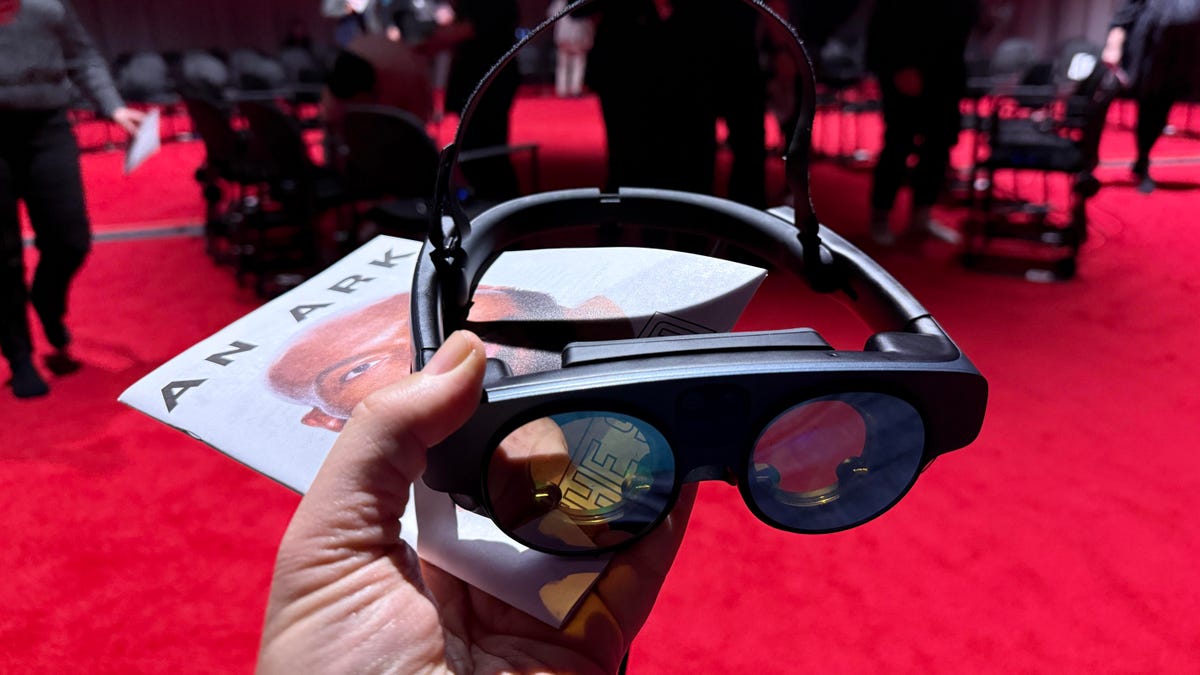
My eyeglasses had to go, too. The shoes were supposedly part of the ritual — a grounding technique to connect me to the floorboards beneath my feet. The glasses, though? Pure practicality. According to CNET, whose reporter braved a genuinely bitter New York evening to attend the same production, the Magic Leap 2 headsets used for the show simply don’t play nice with prescription frames. So there I was, standing in a bathroom stall before curtain time, jamming contact lenses into my eyes just so I could see the ghosts properly.
The ghosts, in this case, were some of the finest actors of our generation.
We gathered in a carpeted room at The Shed in New York City — dozens of us, seated in the round, quietly strapping tethered computers to our faces. An exercise in collective vulnerability, if there ever was one. And then the digital curtain rose. An Ark, billed as the first play created specifically for mixed reality, began to unspool. Holographic performers — including the legendary Ian McKellen — materialized right in the center of our circle.
No live actors. Just us, the audience, sharing the same breathing space while bearing witness to digital phantoms.
You’re Alone in There. So Why Does It Feel Like a Séance?
Having worn enough headsets over the last few years, I know the drill cold. You strap the gear on, and the real world dissolves. You are isolated. Boxed in. Even with pass-through cameras and spatial computing now normalized — however tentatively — by devices like the Apple Vision Pro and the Samsung Galaxy XR, the experience of wearing a headset remains stubbornly solitary. Nobody puts these things on in public to forge a connection with strangers.
An Ark flips that script entirely.
Four virtual chairs materialized in a semicircle directly in front of me. Out of the invisible ether, the actors arrived: Ian McKellen, Golda Rosheuvel, Arinzé Kene, and Rosie Sheehy. They didn’t merely appear — they occupied the space with a heaviness that felt utterly disarming. They looked at me. Right into my eyes.
That eye contact is the anchor of the whole illusion. They confide their stories directly to you, pulling you into the narrative until you start questioning your own place in it. Do they know me? Do I know them?
Here is where the magic trick lives. Every single person in that circular room felt as though those four actors were seated directly in front of them — a simultaneous, overlapping illusion running in parallel across dozens of individual headsets. I couldn’t see the digital chairs projected into the lenses of the woman sitting next to me. I only saw my own ghosts. Yet we were all absorbing the same ambient audio, breathing the same recycled air, shifting in our seats at the exact same emotional beats.
The whole experience is presented as a memorial-like meditation on the liminal space after death. It ends up feeling like we’re all bearing witness together.
Reflections on An Ark
Utterly alone inside our individual software instances, yet entirely synchronized in our physical reactions. A séance — but make it fiber optic.
Ian McKellen Is Performing Six Inches From Your Face. And He’s Not Really There.
The timing of this production reads as deeply intentional. As of early 2026, we are drowning in synthetic media. Our feeds are glutted with AI-generated influencers, fabricated voices, and hyper-realistic video models that look technically flawless but register as hollow the moment you sense something is off.
We are exhausted by it. A Pew Research Center study underscored this growing fatigue, finding that more than half of Americans report acute concern — not excitement — over the relentless absorption of AI into daily human functions. We crave authenticity. Even, apparently, if we have to strap a computer to our skull to find it.
That is what makes An Ark land so hard. No generative AI anywhere in the pipeline. This is raw, human performance, captured with painstaking precision through volumetric video — a technique that records an actor from dozens of simultaneous angles, reconstructing them as a three-dimensional object you can orbit and inspect rather than a flat image projected onto a surface.
Watching McKellen perform in this medium is a revelation — and in practice, the difference registers somewhere below conscious thought, somewhere in your chest. You catch the tiny micro-expressions. The genuine intake of breath before a difficult line. The deeply human hesitation that no language model has convincingly replicated. It is an inversion of our current tech trajectory: instead of deploying computing power to counterfeit human emotion, this production throws immense resources at preserving and transmitting real human emotion as faithfully as physics will allow.
The Hardware Is Sweating. So Are You.
The gear, though, is not invisible. Not yet.
Running nearly 50 minutes, An Ark is a marathon for this specific category of AR hardware. By the time the final act approached, the Magic Leap 2 glasses had grown undeniably warm against the bridge of my nose. The physical weight of the headset began tugging me out of the narrative — suddenly I was hyper-aware of the tether running to the belt-clipped battery pack, the slight thermal bloom building around my temples, the narrowness of the field of view that nobody in the brochure mentioned.
That field of vision, in the hands-on reality of a theatrical setting, was only wide enough to comfortably frame two of the four virtual chairs at a time. To track the other actors’ reactions, I had to physically pivot my head back and forth — slow-motion tennis, but make it Chekhov. A genuine limitation of the tech, no question. Oddly, though, it forced a degree of bodily engagement that traditional proscenium theater almost never demands. You become a participant in your own sightlines.
Todd Eckert — the show’s producer and a former head of content development at Magic Leap — has been stalking this particular quarry for years. He previously produced The Life with Marina Abramović and the haunting AR concert piece Kagami featuring the late Ryuichi Sakamoto. Eckert seems fixated on a single, deceptively complex question: How do you make digital experiences feel safe and coherent inside a shared physical space, among strangers who didn’t sign up to trust each other?
It is a formidable challenge. Statista data shows the global user base for AR and VR technologies has climbed past 100 million — steadily, if not spectacularly — over the last several years. But the overwhelming majority of those users are gaming solo in their living rooms or running enterprise training modules in sterile corporate offices. Group AR — strangers physically gathering to collectively hallucinate the same digital objects in real time — remains almost entirely uncharted.
You Could Stream This From Your Couch. You Shouldn’t.
When the show ended, I peeled off the headset. The sudden absence of the digital actors left the room feeling aggressively vacant — like a stage after the set has been struck. Walking back out to retrieve my shoes from the cubby, I felt a strange decompression settling in my shoulders. Not quite post-show adrenaline. Something quieter. I was emerging from a ritual, and my body knew it before my brain caught up.
Which raises the obvious question lurking behind the whole enterprise: couldn’t I just download this app and watch McKellen perform in my living room?
Technically, yes. Given the right hardware, I could clear my coffee table and summon the actors next to my couch. Having already worked out with holographic trainers on a Meta Quest, I understand the mechanics. The plumbing is roughly similar.
But the emotional resonance would be stone dead.
Doing this alone in a cluttered apartment — takeout containers within arm’s reach, notifications bleeding through — strips away the communal gravity that makes the whole thing function. An Ark works precisely because it demands a pilgrimage. You have to travel to the west side of Manhattan on a freezing night. You surrender your shoes. You sit close enough to strangers to hear them inhale, to feel their bodies shift in the dark when a line hits somewhere tender.
We are still years from a reality where most people own hardware capable of making this happen on a whim. But perhaps casual was never the point. Sometimes the friction of getting somewhere — the cold, the contact lenses, the bathroom-stall prep ritual — is exactly what makes the destination feel like it cost something worth paying.
It was haunting. Emotional in a way that snuck past my defenses, yet undeniably cold at the edges, like pressing your palm to a window on a winter night. Those virtual eyes are still with me — staring across a void that felt, just for a moment, entirely and terrifyingly real.
Based on reporting from various media outlets. Any editorial opinion is that of the author.