We have all felt that particular creeping dread — the low-battery warning that materializes at the exact moment you actually need your device to perform. You buy a Bluetooth tracker to buy yourself peace of mind. You slip it into your luggage, tuck it into the glovebox, or bury it deep in the lining of an expensive hiking backpack. Then you forget about it entirely. That is, until your bag disappears somewhere between a connecting flight in Frankfurt and your final destination. You reach for your phone to locate it. Dead battery. It is a uniquely modern kind of heartbreak — and a completely avoidable one.
Scrolling through tech deals this morning, one specific accessory stopped me cold. Engadget — which runs obsessive daily coverage of everything new in gadgets and consumer electronics — recently spotlighted a quiet little sale on a product that completely flips the script on personal tracking devices. Elevation Lab’s extended battery case for the AirTag is currently sitting at $16, a 30 percent drop from its usual $23 price. On the surface, it sounds like a mundane slab of plastic. A cheap add-on. Easy to scroll past.
Dig a little deeper into what this chunky, unassuming black box actually does, though, and a different story emerges — one about a quiet rebellion against the disposable, high-maintenance hardware cycle we have all been quietly absorbing as normal.
Your AirTag’s Battery Will Outlive Your Next Three Cars
Apple’s AirTags run on a standard CR2032 button cell. Under typical conditions, that little coin battery keeps the tracker pinging the Find My network for just over a year. Replacing it is painless enough — twist the silver cap, pop the old cell out, drop a fresh one in. Simple.
Human nature is the problem. We do not perform preventative maintenance on things that sit silently in the dark, out of sight and therefore out of mind. The battery dies. The tracker becomes a decorative keychain charm.
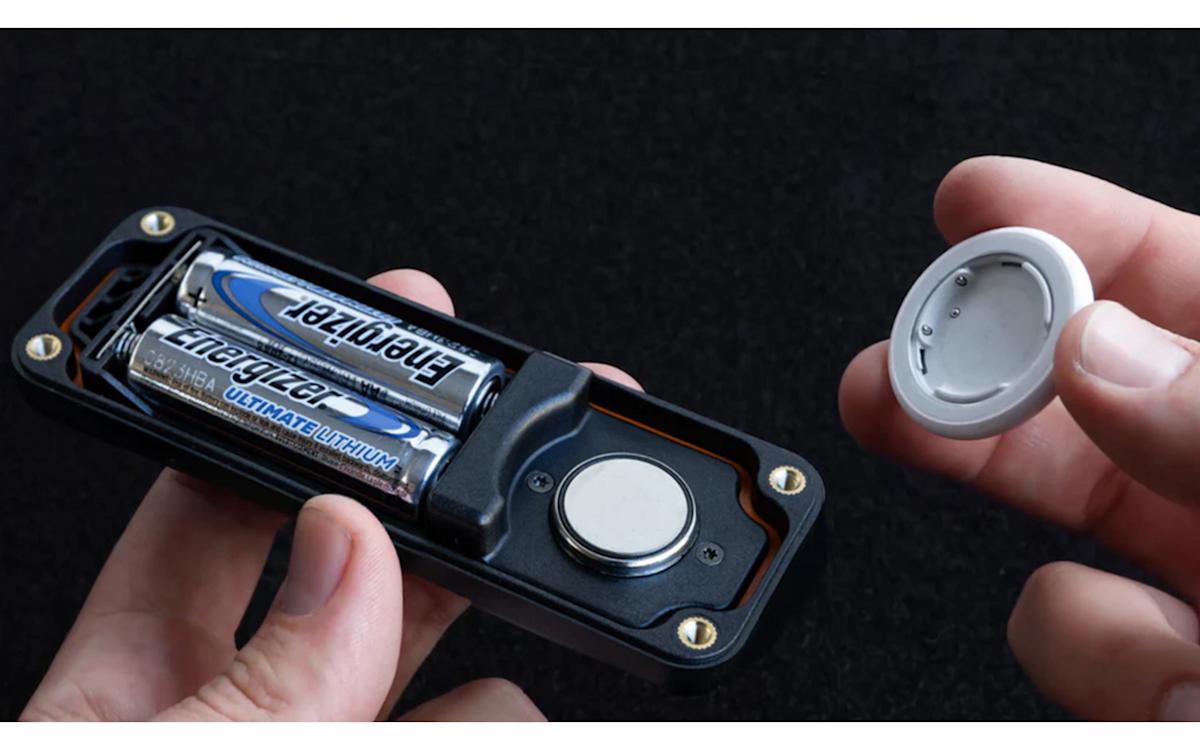
Elevation Lab’s proposition is where things get genuinely fascinating. Their case draws power from two AA batteries — Energizer Ultimate Lithium cells, per the manufacturer’s recommendation for peak performance. By bypassing the tiny internal coin cell entirely and leaning on those AAs, the case stretches the AirTag’s operational lifespan to an almost absurd 10 years. Sit with that for a moment. A full decade. Seal an AirTag into this case today in 2026, and you will not think about its power supply again until 2036. Your next passport renewal will come and go. A child born today will be in fifth grade.
That kind of longevity rewires the entire utility of a tracker. It stops being a passive gadget you have to babysit and becomes something closer to permanent infrastructure for your belongings.
A tracker is only as useful as its weakest link, and historically, that link has always been the user’s memory to replace the battery.
Scale this up and the stakes become hard to ignore. A thorough 2024 analysis from the SITA Baggage IT Insights report found that airlines mishandled nearly 7 million bags globally in a single year. When your suitcase ends up in a holding facility on the wrong continent, the retrieval process can drag on for weeks. A standard AirTag running on fumes from an 11-month-old battery might go dark before the airline even locates the bag. A ten-year power reserve eliminates that ticking clock completely — no more racing against a dying cell while your luggage sits in a Lisbon warehouse.
It Looks Like a Random Piece of Hardware. That’s the Whole Point.
There is a secondary, almost subversive benefit to this bulky case. Bluntly put: it does not look like an Apple product.
The classic AirTag is iconic — gleaming white plastic, polished stainless steel, instantly recognizable from across a room. If someone steals your electric bike or pilfers your camera bag, the very first thing they will scan for is that distinct little white disc. Spot it, and they crush it or pitch it into the nearest storm drain. Gone.
Elevation Lab’s case is a brutalist black plastic brick, held together by four heavy-duty screws. Stumble upon it zip-tied to the undercarriage of a trailer or bolted inside a Pelican case, and it reads as a generic power supply or some nondescript piece of industrial hardware. In practice — having looked at photographs of the thing mounted on actual equipment — it blends into mechanical surroundings in a way the original AirTag never could. That ambiguity makes it substantially less likely that whoever took your gear will clock the fact that they are being actively tracked.
The Acoustic Trade-off (And Why It Might Actually Work in Your Favor)
Physics demands a compromise, of course. Lock a tiny speaker inside a thick, waterproof plastic vault and the sound gets swallowed. Elevation Lab is upfront about this: the auditory ping drops to roughly two-thirds of its normal volume inside the case.
Maddening if you lose your keys in the couch cushions. But this case has no keyring hole. It is far too thick to slip into a wallet. It was engineered for large-scale, long-term tracking — vehicles, freight, heavy equipment, expedition gear bags.
And honestly? A muffled speaker is frequently exactly what you want. If your car is stolen, a loud chime echoing through the cabin is the last thing you need — it tips off the thief before police can recover the vehicle. Silence is the asset. Worth noting, too: the second-generation AirTag is measurably louder than the original model. If you are running the newer hardware, the volume reduction from the case barely registers as a practical issue.
Then there is the durability factor, which deserves its own mention. The case carries a stringent IP69 waterproof classification — and that distinction matters. IP68 means a device survives submersion. IP69 means it can withstand high-pressure, high-temperature water jets. Bolt this thing to the outside of an off-road vehicle, drive it through a mud bog, hit it afterward with a pressure washer — the AirTag inside stays perfectly dry and operational. That is not a spec you see on many $16 accessories.
The Quiet Case Against Planned Obsolescence
Zoom out from the specs, and something more meaningful comes into focus. Products like this hint at a course correction that consumer electronics has been desperately overdue for.
We are drowning in disposable technology. The United Nations Global E-waste Monitor reported that humanity generates over 62 million tonnes of electronic waste annually — a figure climbing at an alarming rate, according to the organization’s most recent data. A substantial portion of that mountain consists of perfectly functional devices discarded solely because their internal batteries degraded and could not be easily swapped out. The device still worked. The battery did not. Into the landfill it went.
By migrating the power source to standard, replaceable AA cells — and stretching the replacement cycle to a full decade — this $16 case quietly rejects the logic of planned obsolescence. It forces the hardware to operate on your timeline, not the manufacturer’s quarterly roadmap. That is a genuinely radical position for a piece of plastic that costs less than a decent lunch.
Is this case practical for everyday items?
Not remotely. The extended battery case adds serious bulk — it transforms a coin-sized tracker into something resembling a small block of cheese, as one reviewer aptly put it. This is strictly a tool for long-term luggage tracking, vehicles, heavy equipment, and expedition gear bags where spatial constraints are not a concern. Do not try to slip it into a jacket pocket.
Do I have to use lithium batteries?
Standard alkaline AAs will work, but they will not last anywhere near as long and are prone to leaking battery acid over the course of several years — which would be a spectacularly bad outcome inside a sealed waterproof case. Lithium AA batteries are the clear choice: they resist extreme temperature swings, hold an impressively stable shelf life, and are far less likely to cause any internal damage over a multi-year deployment.
Spending $16 to sidestep a decade of battery anxiety is, when you lay it out plainly, a straightforward calculation. Rare is the cheap accessory that genuinely improves the core functionality of a premium device rather than just wrapping it in a different color silicone. We spend enormous mental energy worrying about our tech — charging it, updating it, protecting it from every conceivable threat. Finding a solution that simply asks you to screw a lid shut, walk away, and not think about it again until the mid-2030s? That is worth more than the sticker price suggests.
Reporting draws from multiple verified sources. The editorial angle and commentary are our own.