Listen, there is a very specific, very localized kind of madness that seems to only exist within the walls of Nintendo’s Kyoto headquarters. It’s a brand of creative stubbornness that simply refuses to let a “bad” idea die if there’s even a one-percent chance they can figure out how to make it fun three decades later. We’ve seen this play out before, haven’t we? We saw it with the revival of those tiny Famicom controllers and the company’s brief, wonderful obsession with DIY cardboard kits. But today, we’re looking at what might be the ultimate comeback story in gaming history: the Virtual Boy. Yes, you read that right. The crimson-tinted, headache-inducing machine from 1995 is officially back from the dead, arriving as a brand-new accessory for the powerhouse Switch 2. And honestly? It’s the most Nintendo thing I’ve ever heard.
The Red-Tinted Fever Dream We Never Asked For (But Kind of Wanted)
According to reports from Engadget—that web magazine we all check daily for our fix of gadget obsession and consumer tech news—this new Virtual Boy accessory is set to launch in just a few days, on February 17. It’s been designed specifically to bridge the gap between the Switch 2’s beefy modern internals and the quirky, experimental VR spaces Nintendo has been flirting with for years. Now, if you’re sitting there scratching your head and wondering why on earth Nintendo would choose to revive their biggest hardware flop of all time, you aren’t alone. I had the same thought. But then again, if you’ve been following this company for as long as I have, you know that “why” is usually the wrong question to ask. The real question, the one that actually matters when it comes to Nintendo, is: “Just how weird is this going to get?”
Let’s take a quick trip down memory lane, shall we? The original Virtual Boy was, by almost every metric, a total disaster. It sold roughly 770,000 units worldwide before Nintendo finally put it out of its misery. To put that in perspective, that’s a mere rounding error compared to the 140 million-plus units the original Switch moved. It was a failure of epic proportions. Yet, here we are in 2026, and Nintendo is unironically asking us to strap a red-filtered goggles-and-stand combo to our shiny, expensive new Switch 2 consoles. It’s a move that feels equal parts nostalgic and slightly masochistic. It’s the kind of thing only Nintendo could pull off without being laughed out of the room—though, let’s be honest, there’s still plenty of laughing happening.
But that’s the charm, isn’t it? In an industry that is so often obsessed with “safe” bets and incremental upgrades, Nintendo is out here digging through its dumpster of failed ideas to see if they can find a diamond in the rough. And if history has taught us anything, it’s that they usually do. Whether it’s the Wii’s motion controls or the DS’s dual screens, Nintendo’s best successes often start as ideas that people initially ridiculed. Is the Virtual Boy revival a stroke of genius or just a very expensive joke? We’re about to find out.
Pick Your Poison: Do You Want the ‘Premium’ Tripod or the Cardboard Pizza Box?
Nintendo is giving us a choice this time around, and in true Nintendo fashion, it’s a weird one. You can either grab the “authentic” hardware version for a cool $100, or you can go the DIY route and pick up a cardboard version for just $25. Now, usually, in the world of high-end tech, the “premium” version is the one you’re supposed to want. You want the plastic, the weight, the feeling of “quality.” But early impressions from those who have gone hands-on suggest that for this particular Virtual Boy accessory, the cardboard might actually be the superior way to play. It sounds absolutely ridiculous, doesn’t it? You spend $400 or more on a cutting-edge console just to stick it inside a $25 pizza box. And yet, here we are.
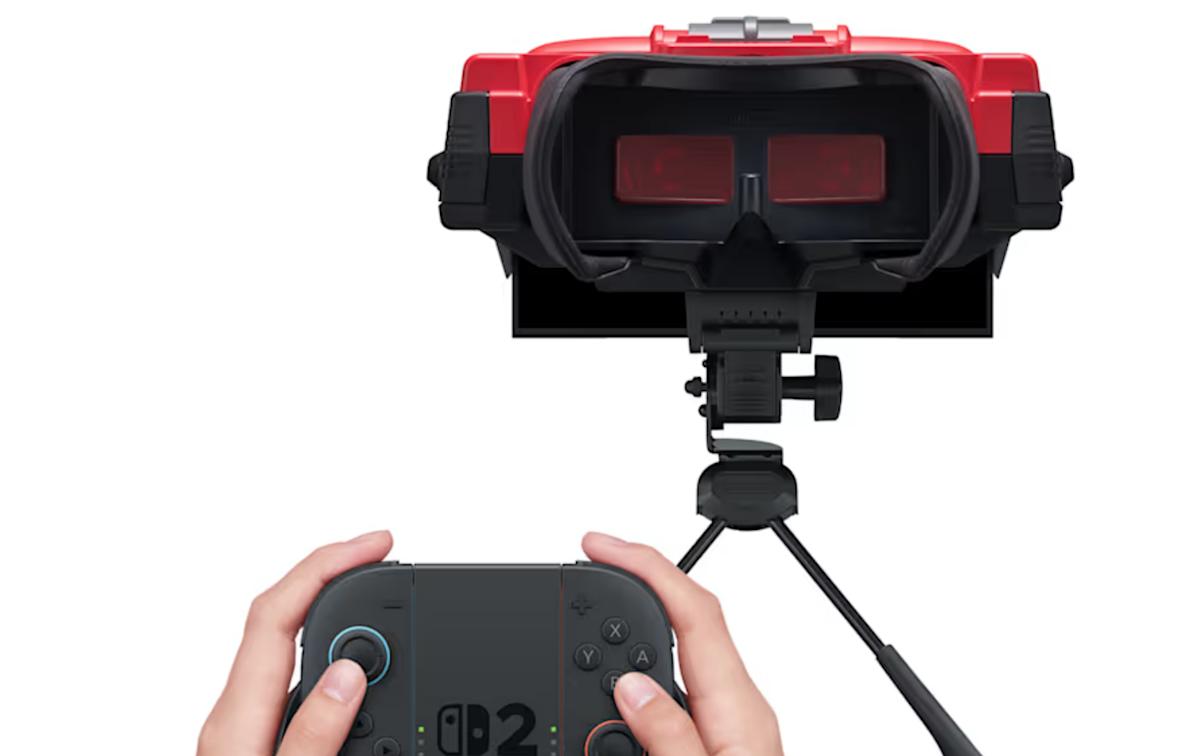
The hardware version is built like a tank. It sits on a tripod that perfectly mimics that iconic 1995 design. And while it looks absolutely fantastic sitting on a shelf—it’s a real conversation starter for any gaming den—it is, quite literally, a pain in the neck. You have to lean into it, keeping your head completely static while the digital world moves around you. It’s awkward. It’s rigid. In stark contrast, the cardboard version—which feels very much like a spiritual successor to the Labo VR kit—is handheld. You can actually move your head. You can look around the lush forests of the Kingdom of Hyrule or peer into the diorama-like stages of Captain Toad: Treasure Tracker without feeling like you’re wearing a medieval neck brace. It’s a classic case of function over form, even if that function comes in the form of recycled paper.
And then there’s the matter of that infamous red filter. The hardware unit includes actual red lenses to mimic the original “monochrome red” look that defined the 90s experience. Thankfully—and I mean thankfully—these lenses are removable. I actually tried the original Virtual Boy back in the day, and let me tell you, thirty minutes of Mario’s Tennis felt like staring directly into the coils of a heat lamp for an afternoon. Being able to toggle that filter off is a mercy that my retinas are already thanking Nintendo for. But for the purists out there? The red filter is the whole point. It’s a vibe. A very specific, very intense, migraine-inducing vibe that captures a moment in time better than any 4K resolution ever could.
“The revamped accessory is just as eccentric and ungainly as the original was three decades ago, proving that Nintendo values its heritage of weirdness over modern ergonomic standards.”
— Hardware Reviewer Perspective
The Labo Legacy and Closing the Switch 2 Compatibility Gap
One of the biggest, most practical reasons this accessory even exists is to solve a nagging compatibility problem. The original Nintendo Labo VR set was a charming, if short-lived, experiment. It was fun for a weekend, but as many early Switch 2 owners have quickly discovered, those old cardboard constructs don’t really play nice with the new hardware. The Switch 2 is a different beast entirely—it’s bigger, it’s faster, and its dimensions are just different enough to make the old Labo kits obsolete. The Virtual Boy accessory acts as the official “VR Bridge” for this new era of Nintendo gaming. It’s the way they’re bringing that legacy forward without forcing us to tape our new consoles into old boxes.
We’re getting four main titles right out of the gate to support the launch: Super Mario Odyssey, Super Smash Bros. Ultimate, The Legend of Zelda: Breath of the Wild, and the aforementioned Captain Toad. Now, let’s be clear here: these aren’t full-blown VR remakes. They are essentially the same VR modes we saw on the original Switch. But—and this is a big “but”—playing Breath of the Wild in VR on a Switch 2 is a significantly better experience than it ever was before. The increased resolution and the rock-solid frame rates of the new console finally make these modes feel like something more than just a flickering tech demo. No more “screen door” effect making Link look like he’s been built out of LEGO bricks. It’s smoother, sharper, and actually playable for more than five minutes at a time.
But here’s the catch, and it’s a bit of a sting for the long-time fans: if you’re an “OG” Switch fan clinging to your original Labo headset, you’re out of luck when it comes to the new retro content. The Virtual Boy library that’s heading to the Nintendo Switch Online + Expansion Pack is strictly locked to these new accessories. It’s a bit of a bummer, I know, but it’s a classic Nintendo move. They want to nudge you toward the new shiny hardware (or the new shiny cardboard). It’s their way of saying, “We appreciate your loyalty, but it’s time to upgrade your face-box.”
The Big Picture: Why Nintendo Doubling Down on VR Actually Matters
It’s easy to look at this and dismiss it as just another toy, but I think there’s a much deeper strategy at play here. While tech giants like Sony and Meta are currently locked in a high-stakes, multi-billion dollar war for “immersion,” building headsets that cost as much as a decent used car, Nintendo is playing a completely different game. They aren’t interested in the metaverse or hyper-realistic haptic feedback. They are treating VR as a novelty, an accessory, and a toy. And honestly? Looking at the current state of the industry, that might actually be the smarter play for the mass market.
Think about it. According to a 2024 Pew Research report, about 14% of US adults had used a VR headset, but sustained, daily use remains a massive challenge for the entire industry. People buy these expensive rigs, play with them for a week or two, and then they inevitably start gathering dust on a shelf next to the bread maker. By pricing their entry point at a measly $25 for the cardboard version, Nintendo removes that massive barrier to entry. They aren’t asking you to change your lifestyle or invest your life savings; they’re just asking you to have a fun Saturday afternoon looking at Mario in 3D. It’s low-stakes, high-reward fun.
Furthermore, data from Statista indicates that while the global VR market is expected to grow significantly, the “entry-level” segment is often completely underserved. Nintendo isn’t trying to compete with the Apple Vision Pro or the high-end PC VR market. They are leaning into their core identity as a toy maker. They know that the “Virtual Boy” name carries a certain weight with older gamers—a weird mix of irony, nostalgia, and genuine curiosity. By reviving it now, they’ve managed to turn a historical failure into a modern marketing win. It’s brilliant, in a chaotic sort of way.
The “Red” Nostalgia Factor and the Punk Rock Aesthetic
There’s also something to be said for the pure aesthetic of the thing. In an age of 4K OLED screens, photorealistic ray-tracing, and perfectly smooth polygons, the harsh, unapologetic red-and-black palette of the Virtual Boy stands out like a sore thumb. And that’s why it works. It’s punk rock. It’s lo-fi. It’s the kind of thing that looks incredible on an Instagram feed and feels “retro” in a way that 16-bit pixels just don’t anymore. Nintendo knows their audience inside and out. They know that the same people who stood in line to buy a Switch 2 on launch day are the exact same people who will happily drop $100 for a plastic stand just because it looks like a piece of gaming history. It’s not about the tech; it’s about the feeling.
Can I play regular Switch 2 games with the Virtual Boy headset?
Not exactly, and this is an important distinction. The headset is specifically designed for games that have a dedicated VR mode or for the specific Virtual Boy library coming to Nintendo Switch Online. You can’t just boot up Metroid Prime 4 and expect it to work in VR unless Nintendo releases a specific update for it. It’s a curated experience, not a universal one.
Is the $100 hardware version actually worth the extra cash?
That really depends on what kind of gamer you are. If you’re a hardcore collector or someone who plans on spending hours diving deep into the original Virtual Boy library, then yes, the hardware version is the way to go. That static stand is exactly how those games were meant to be played back in the 90s. However, if you’re mostly interested in modern “VR-supported” titles like Zelda, the $25 cardboard version is actually much more comfortable and intuitive because it allows for natural head tracking. Plus, you won’t feel as bad when you eventually stick it in a closet.
The Final Verdict: A Charming, Clunky, and Completely Necessary Piece of History
So, should you actually go out and buy this thing when it drops on the 17th? If you’re a Nintendo enthusiast, let’s be real—you probably already have the My Nintendo Store tab open and you’re just waiting for the “Add to Cart” button to turn green. It’s a piece of gaming history that you can actually use, which is a rare thing. But for the average person? It’s a much tougher sell. It’s ungainly, it’s niche, and it is undeniably weird. But that’s exactly why we love Nintendo, isn’t it?
In a world where every other tech company is trying their hardest to be “sleek,” “minimalist,” and “professional,” Nintendo is out here selling us cardboard goggles and 30-year-old red-tinted nightmares. It’s a refreshing reminder that gaming doesn’t always have to be about having the highest resolution or the most realistic graphics. Sometimes, it’s just about the simple, tactile joy of sticking your face into a plastic box and seeing a plumber jump around in three dimensions. It’s silly, it’s unnecessary, and it’s wonderful.
The Switch 2 is an incredibly powerful machine, and seeing it used for something as whimsical and “un-pro” as this gives me a lot of hope for the future of the console. It shows that Nintendo hasn’t lost its soul or its sense of humor in the transition to more powerful hardware. They’re still the same eccentric company that thought a red-and-black headset on a tripod was a good idea back in 1995. And in 2026, I’m genuinely glad they still think so. Now, if you’ll excuse me, I need to go find some aspirin and prepare my eyes for the crimson glow.
This article is sourced from various news outlets. Analysis and presentation represent our editorial perspective.