For the last three years, it feels like we’ve been collectively trapped in a loop, obsessing over the latest chatbot updates. We’ve spent countless hours arguing about whether these models can actually write “real” poetry, if they’re coming for our copywriting jobs by next Tuesday, or if they’re just what the critics call “stochastic parrots”—glorified autocomplete machines that mimic human speech without a lick of actual understanding. But while the rest of the world was busy trying to trick ChatGPT into saying something controversial, a small, focused team in London was quietly tackling a much more visceral problem: they were teaching machines how to actually live and breathe in the physical world. I’m talking about Stanhope AI. Looking back now from the early days of 2026, their 2024 seed round feels like the exact moment the industry finally woke up and realized that “thinking” in a vacuum and “doing” in the dirt are two entirely different things.
If you track back to the original reports from The Next Web, Stanhope AI closed an $8 million (€6.7 million) seed round in early 2024. Their mission? To push what they call their “Real World Model” out of the lab and into the wild. The round was led by Frontline Ventures, with some serious heavy hitters like Paladin Capital Group and the UCL Technology Fund joining the fray. At the time, if you weren’t paying close attention, it might have looked like just another AI startup grabbing its slice of the venture capital pie. But it was much more than that. It was a fundamental, strategic bet against the “bigger is better” philosophy that has defined the Large Language Model (LLM) era. Instead of feeding a machine the entire internet just to help it draft a LinkedIn post, Stanhope wanted to give a drone enough internal “brainpower” to navigate a wind-swept battlefield or a chaotic, cluttered warehouse without needing to be tethered to a massive data center a thousand miles away. It was about autonomy, in the truest sense of the word.
Why we’re finally moving past the ‘Chatbot Era’ of robotics
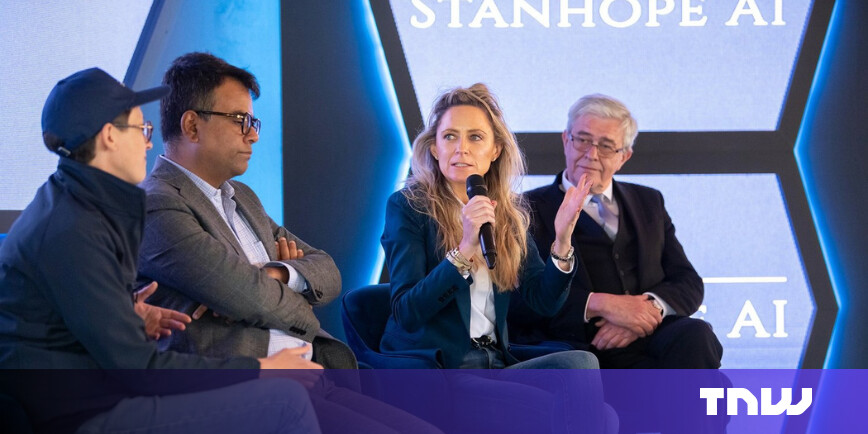
Let’s be brutally honest for a second: LLMs are incredibly impressive, but they’re also kind of “dumb” the moment they step off the screen and into the physical world. They are, at their core, master pattern matchers. They know with statistical certainty that the word “apple” usually follows the word “red,” but they don’t have a fundamental grasp of gravity, inertia, or the sheer, messy unpredictability of a sudden gust of wind hitting a rotor blade. This is exactly where Stanhope AI decided to draw a line in the sand. They weren’t particularly interested in language for language’s sake; they were interested in agency. Professor Rosalyn Moran, the CEO, hit the nail on the head when she explained that they were moving toward an intelligence that doesn’t just process data, but possesses the ability to act in order to understand its world. It’s a subtle distinction, but it changes everything about how we build machines.
This shift wasn’t just an academic preference—it was a necessity. By 2024, the cracks in the cloud-based AI model were starting to show. If you’re the one operating a defense drone in a high-stakes environment or managing an autonomous delivery robot on a busy city sidewalk, you simply cannot afford a two-second latency gap while the robot sends a “ping” to a server in Virginia to ask what it should do about a sudden obstacle. It has to know. It has to know now. According to a 2024 report by Precedence Research, the global AI in robotics market was valued at roughly $15.54 billion, and a massive chunk of that growth was being fueled by the desperate need for exactly this kind of on-device, “edge” intelligence. Stanhope wasn’t just trying to build a faster algorithm; they were essentially building a survival instinct for machines that have to operate in the real world.
And that’s really the kicker here. Most AI we interact with today is reactive—it waits for a prompt and then responds. Stanhope’s tech, however, is deeply predictive. It utilizes a “Real World Model” that allows a machine to constantly update its own internal map of reality based on a continuous stream of sensory input. Think about the difference between a robot following a rigid, pre-programmed path and a robot that “feels” its way through a room, adjusting its movements much like a cat or a human would. It’s messy, it’s incredibly complicated, and it’s exactly what we needed to finally get robots out of the pristine conditions of the lab and onto the unpredictable streets of the real world. We’re talking about machines that can handle the “noise” of reality without breaking down.
The Friston Factor: What happens when you build a drone with a biological blueprint?
You really can’t have a serious conversation about Stanhope without bringing up Professor Karl Friston. For those of you who aren’t deep in the neuroscience weeds—and let’s be honest, most of us aren’t—Friston is essentially a rockstar in the field. He’s the genius behind the “Free Energy Principle,” which is a very sophisticated way of saying that all living things are hardwired to minimize “surprise” or uncertainty. It’s how your own brain works right this second. You’re constantly making tiny, subconscious predictions about what’s going to happen next—where your foot will land, how heavy that coffee mug is—and when you’re wrong, your brain instantly updates its model. It’s incredibly efficient, it’s lightning-fast, and perhaps most importantly, it requires a surprisingly small amount of power to function.
“We’re moving from language-based AI to intelligence that possesses the ability to act to understand its world – a system with a fundamental agency.”
Professor Rosalyn Moran, CEO and co-founder of Stanhope AI
What Stanhope did was take this biological blueprint and bake it directly into silicon. This is the secret sauce behind why their models can run on “edge” devices—those small, low-power chips you find tucked inside drones and industrial robots. While the rest of the tech world was busy building AI that requires the power consumption of a small city just to run a few queries, Stanhope was looking at how the human brain manages to perform miracles on about 20 watts of power (roughly the same as a dim lightbulb). It’s a complete 180-degree turn from the “brute force” approach favored by Silicon Valley. They realized early on that if a robot is ever going to be truly useful in a search-and-rescue mission in the mountains or on a remote, off-grid farm, it has to be self-sufficient. It can’t be sitting there waiting for a 5G signal that might never show up.
The implications of this are, frankly, huge. By leaning on these neuroscience principles, they’ve created systems that can actually learn on the fly. Most traditional AI models are “frozen” once they finish their training phase; if you show them something they haven’t seen before, they tend to hallucinate or just break entirely. Stanhope’s models, by design, are built to be “surprised.” They expect the unexpected, and then they learn from that surprise in real-time. It’s a level of adaptability that was almost unheard of in the robotics space until they started deploying their tech with international partners throughout late 2024 and 2025. It’s the difference between a machine that knows a set of rules and a machine that understands the game.
The death of the cloud: Why ‘Edge AI’ is basically a survival instinct for machines
We often talk about “the cloud” as if it’s this magical, omnipresent entity that solves all our problems. But for a robot trying to navigate the physical world, the cloud isn’t a feature—it’s a liability. A 2025 study by Gartner suggested that a staggering 75% of enterprise-generated data would be processed at the edge—meaning right there on the device itself—by the end of last year. Why the sudden shift? Because bandwidth is expensive, latency is a literal killer in autonomous systems, and privacy has become a total nightmare for most companies. Stanhope was way ahead of the curve on this, designing their models to be lightweight and efficient from day one. They didn’t want their robots to be “remote-controlled” by a server; they wanted them to be independent.
Think about a drone trying to navigate through a dense forest. It has to simultaneously process high-res visual data, calculate shifting wind speeds, monitor battery levels, and keep its mission objectives in mind. If that drone has to send all that data to the cloud just to decide whether to veer left or right to avoid a sudden branch, it’s going to hit the tree before the answer even comes back. It’s that simple. Stanhope’s “Real World Model” allows the drone to make those split-second decisions locally. This isn’t just some minor technical achievement; it’s a massive paradigm shift in how we think about machine autonomy. We’re finally moving away from “remote-controlled AI” and toward something that resembles true, independent agency.
But it’s not just about raw speed. It’s also about data efficiency, which is something we don’t talk about enough. Standard deep learning requires millions, sometimes billions, of examples to learn even a simple task. Stanhope’s approach, which is rooted in computational neuroscience, allows machines to learn from much, much smaller datasets. This is absolutely crucial for industries like defense or specialized manufacturing. In those fields, you don’t always have a billion images of a specific “edge case” or a rare malfunction to train on. You need the machine to see something once or twice and say, “Okay, I get it now. I know how to handle this.” That kind of “small data” learning is the holy grail of practical AI.
The uncomfortable reality of giving ‘agency’ to defense tech
Of course, we have to talk about the elephant in the room: the defense industry. It’s no coincidence that Stanhope’s funding round included Paladin Capital Group, a firm that knows its way around global security and national interests. There’s no point in sugar-coating it—this kind of adaptive, independent AI is an absolute game-changer for autonomous weaponry and surveillance. When a drone can navigate a jammed environment without relying on GPS or a constant data link, it becomes a very different, and much more formidable, kind of tool. Christopher Steed from Paladin was quite vocal about this during the seed round, pointing out how relevant adaptive AI is for “critical and security-sensitive applications” where failure isn’t an option.
From an editorial perspective, this is where things get a bit sticky. The idea of “agency” in a machine that might be carrying a payload is enough to make anyone stop and think. However, there’s a compelling argument to be made that smarter drones are actually safer drones in the long run. A drone that truly understands its environment and its own limitations is far less likely to make a catastrophic error because of a sensor glitch or a digital “hallucination.” If a machine has a better, more grounded model of the “real world,” it’s more likely to behave in a predictable, reliable way even when it’s under extreme pressure. It’s about reducing the “surprise” that leads to accidents.
By 2026, we’ve also seen the “Sovereign AI” movement really take flight across Europe. Countries are starting to realize that they can’t just outsource their critical infrastructure and intelligence to US or Chinese tech giants. Stanhope AI, as a spin-out from UCL and King’s College London, represents a massive win for the UK’s deep tech ecosystem. They are proving to the world that you don’t need a trillion-dollar valuation or a warehouse full of H100s to build something that fundamentally changes the architecture of intelligence. Sometimes, you just need a really, really good understanding of how biological brains actually solve problems. It’s a testament to the power of interdisciplinary thinking—mixing neuroscience with hard engineering.
What makes Stanhope AI different from ChatGPT?
While ChatGPT is a Large Language Model (LLM) designed to predict the next word in a sentence based on text data, Stanhope AI builds what they call “Real World Models.” These are specifically designed for physical systems like robots and drones. Instead of just talking, these models allow machines to perceive, reason, and act in messy, uncertain environments without needing a constant connection to the cloud. It’s the difference between a philosopher and an athlete.
Why is “Edge AI” so important for robotics?
Edge AI refers to the ability to process data directly on the device itself rather than sending it off to a remote data center. For things like robots and drones, this is a total dealbreaker. It eliminates latency (that annoying delay), saves a ton of power, and—most importantly—allows the machine to keep working in “dark” areas where there’s no internet or GPS signal. If it can’t think on its own, it’s just a very expensive brick the moment the signal drops.
How does neuroscience play a role in their technology?
Stanhope AI’s tech is built on the “Free Energy Principle,” a theory championed by world-renowned neurobiologist Professor Karl Friston. It essentially mimics the way our own brains work: by making constant, low-energy predictions about the environment and then updating those predictions the moment sensory feedback says otherwise. This makes the AI much more efficient and adaptable than traditional “brute-force” machine learning models.
Looking back from 2026: Was the ‘Real World Model’ a revolution or just a pivot?
Looking back at that $8 million round from February 2024, it’s now blindingly clear that Stanhope was the canary in the coal mine for the “Agentic AI” revolution. We’ve finally moved past the novelty phase where we were impressed by AI that could write a decent email or a funny haiku. We’re now firmly in the era of AI that can actually do things in the physical world. Whether it’s a drone autonomously inspecting high-voltage power lines in a storm or a robotic arm navigating a disorganized warehouse floor, the “Real World Model” has become the gold standard for how we integrate intelligence into the things we build.
But let’s be real—the journey isn’t exactly over. The big challenge for Stanhope, and for the entire robotics industry, remains that tricky bridge between brilliant academic theory and reliable mass-market deployment. It’s one thing to have a drone successfully navigate a controlled lab at UCL; it’s a whole different ballgame to have a fleet of them operating reliably in the middle of a hurricane or a construction site. But if the last two years have taught us anything, it’s that the biological approach—focusing on agency, efficiency, and prediction—was the right path to take. We aren’t just building faster computers anymore; we’re finally building machines that “get” the world they live in. And that’s a huge step forward.
In the grand scheme of things, that $8 million seed round might have seemed small compared to the billions being poured into the likes of OpenAI or Anthropic. But in terms of actual impact per dollar, Stanhope might have been one of the smartest bets of 2024. They didn’t just build a better chatbot or a shinier interface; they gave robots a brain that works. And honestly? To me, that’s a whole lot more interesting and consequential than a machine that can write a sonnet about a pepperoni pizza. We’re finally seeing what happens when AI grows some legs—or wings—and actually starts interacting with the world we inhabit.
This article is sourced from various news outlets. Analysis and presentation represent our editorial perspective.