I was sitting on my sofa last night, just staring at the screen while that familiar, infuriating little “Are you still watching?” prompt mocked me. It was followed almost immediately by the dreaded rotating wheel of death, a clear sign that my supposedly lightning-fast gigabit fiber was somehow failing to keep up with the demands of a Tuesday evening. It’s a funny thing when you stop to think about it. Here we are, well into the early months of 2026, living in a world defined by 8K streaming, ubiquitous AI-generated content, and hyper-personalized algorithms, yet I found myself reaching for a piece of technology that my grandfather would have recognized instantly. According to the latest industry news, this isn’t just some weird, nostalgic glitch in the matrix. The massive resurgence of the humble indoor TV antenna is a full-blown movement. It’s being driven by people who are simply exhausted by the “subscription tax” that has become the mandatory entry fee for modern entertainment.
There’s a deep, almost painful irony in where we’ve ended up. We spent the better part of the last decade running away from the perceived “clutter” of physical media and broadcast signals, chasing the dream of everything-on-demand. We wanted to escape the cable box, only to find ourselves trapped in a fragmented, expensive web of $20-a-month apps that, somehow, often offer less than the local news used to provide for free. Last year, the industry finally hit a visible breaking point. We’ve watched the “Streaming Wars” devolve into a pure war of attrition against our bank accounts. That is exactly why these little plastic rectangles—the sleek, high-tech descendants of the old-school rabbit ears—have quietly become the most radical, counter-cultural piece of technology you can actually own today. They represent a refusal to play the game on the streamers’ terms.
The Math of the Great Reversal: Why Free Airwaves Suddenly Feel Like Freedom Again
Let’s be brutally honest about the current state of cord-cutting. It was sold to us as a revolutionary way to save money, a way to pick and choose only what we wanted. But as we sit here in February 2026, the math has fundamentally shifted. According to a recent 2025 Statista report, the average American household is now shelling out well over $95 every single month just to maintain a basic handful of top-tier streaming services. When you start adding in the inevitable, biannual price hikes and those “ad-supported” tiers that feel suspiciously like the old cable TV we tried so hard to escape, that “free” signal floating invisibly through your living room starts to look like a literal gold mine. It’s money left on the table every single day you don’t have a way to catch it.
The real beauty of an antenna in 2026 lies in its stubborn, wonderful simplicity. It doesn’t require a complex login or a two-factor authentication code sent to your phone. It doesn’t track your viewing habits to sell your data to a company trying to pitch you a specific brand of eco-friendly laundry detergent. It doesn’t care about your bandwidth or your router’s firmware. It just grabs the signal out of the air and puts it on your screen. For anyone who grew up in the analog era, adjusting a physical dial to get a fuzzy, ghost-filled picture of the local football game, the sheer quality of modern ATSC 3.0 broadcasts is nothing short of a revelation. We’re talking about crisp 4K resolution, HDR color depth, and theater-quality sound—all of it pulled out of thin air for the one-time cost of a decent dinner out. It’s the ultimate “buy once, cry once” investment.
But here’s the kicker that many people miss: not all antennas are created equal. I’ve seen so many people grab a $5 piece of junk from a gas station or a bargain bin and then act shocked when they can only see the local weather channel through a blizzard of digital static. If you’re going to commit to this, you have to do it the right way. You’re essentially trading a recurring monthly bill for a small, one-time bit of upfront engineering. You have to respect the tech if you want it to work for you.
The Heavyweight Champion: Why the Mohu Gateway Plus Still Leads the Pack
If you’re searching for the absolute gold standard in this space, the Mohu Gateway Plus has firmly solidified its position as the one to beat. Currently sitting at about $80, it certainly isn’t the cheapest option on the shelf, but I’ve always been a firm believer that you shouldn’t cheap out on the primary gateway to your daily entertainment. I’ve personally tested dozens of these units over the years, and the Gateway Plus consistently stands out because it actually respects the physical reality of your living room. It’s designed to handle the messiness of real-world environments.
“The best antenna isn’t the one with the most marketing jargon or the flashiest packaging; it’s the one that manages to find a stable signal in a room full of electronic interference and physical obstacles.”
— Tech Editorial Review, 2025
What I genuinely love about this model—and what I truly wish more manufacturers would pull their heads out of the sand and copy—is the integrated LED signal meter. It might sound like a minor, “nice-to-have” feature, but if you’ve ever spent a frustrating afternoon moving an antenna half an inch to the left, then back to the right, while someone yells “Is it better now?” from the couch, you know exactly why this matters. The LEDs give you real-time, objective feedback. It turns a frustrating guessing game into a precise, satisfying science. You can actually see the signal strength as you move it, which saves you hours of trial and error.
In terms of its physical presence, it’s a bit of a “chunky monkey,” measuring roughly 8 by 11 inches. However, it’s designed with enough sleekness that it doesn’t look like a leftover prop from a low-budget 1950s sci-fi movie. It boasts a 60-mile range, which is more than enough for the vast majority of suburban dwellers. In my own testing, it managed to pull in those stubborn, distant channels that smaller, unamplified pads simply couldn’t see. So, is it worth the $80? Well, if it saves you $1,000 in cable and streaming fees over the next year, the ROI is pretty undeniable. It pays for itself in less than a month.
The “No-Frills” Reality of the Best Buy Essentials Model
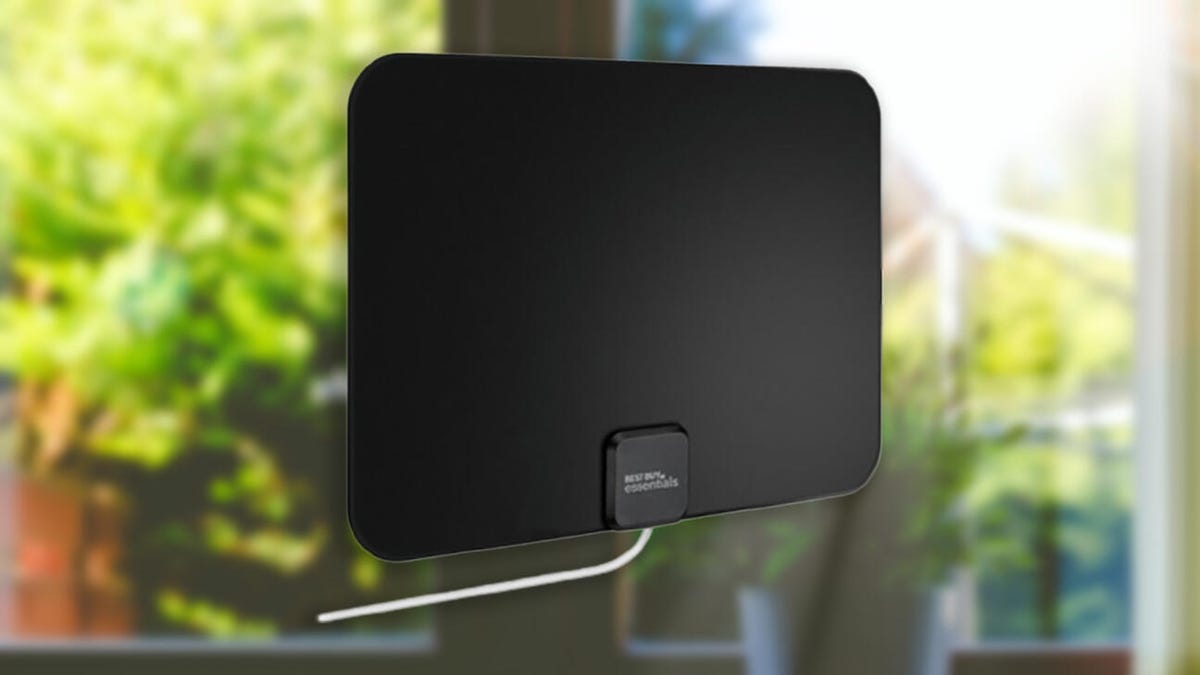
On the complete flip side of that coin, we have the Best Buy Essentials Thin Indoor HDTV Antenna. It’s $20. It has no fancy amplifier, no high-tech LEDs, and honestly, it looks like a laminated piece of black construction paper. And yet, for a massive chunk of the population, it’s actually all you really need. If you happen to live in a major city or within 15 to 20 miles of a primary broadcast tower, buying an $80 amplified antenna is a lot like buying a Ferrari just to drive to the end of the driveway to check the mailbox. It’s complete overkill, and in some cases, it can actually be counterproductive.
According to the latest consumer reports, this budget-friendly option has become an absolute staple for apartment dwellers and people living in urban corridors. It’s a simple, unassuming 11.75-inch rectangle that comes with a 10-foot cable. You just stick it to a window, plug it into the back of the TV, and let the tuner do its thing. It’s the ultimate “set it and forget it” device for the modern age. It serves as a great reminder that sometimes, the tech industry tries way too hard to over-engineer solutions to problems that were actually solved decades ago. You don’t always need a computer-controlled amplifier to watch the evening news.
There’s a broader lesson here about modern consumerism and how we’re marketed to. We’re constantly told that “more” is always “better”—more features, more power, more cost, more complexity. But the Best Buy Essentials model proves that “enough” is often the real sweet spot. If you’re just trying to catch the local news, the weather, and the Sunday night game, why pay for signal processing you don’t actually need? It’s the Honda Civic of antennas: it’s not flashy, it won’t win any beauty contests, but it gets you exactly where you’re going every single time without any drama.
Do I really need an amplified antenna for my setup?
Not necessarily, and this is a common misconception. Amplifiers are fantastic if you’re living far from a broadcast tower or if your signal has to travel through a lot of walls. However, if you’re relatively close to the source, an amplifier can actually “overload” your TV’s digital tuner, making the picture quality worse or causing channels to drop out entirely. My advice? Start with a non-amplified one if you’re in a city and see what you get first.
Will a standard indoor antenna work in a rural area?
The honest answer is: probably not. If you’re more than 50 or 60 miles away from the nearest broadcast tower, or if you have a mountain range sitting between you and the signal, an indoor antenna is going to struggle. In those cases, you’ll likely need to look into an outdoor antenna mounted high on your roof or a dedicated mast to get a signal that’s actually stable enough to watch.
The Geography of Airwaves: Why Your Mileage Will Literally Vary
The one thing the slick marketing materials and the Amazon listings won’t tell you is that your house might effectively be a Faraday cage. I’ve seen people go out and buy the absolute best Mohu unit on the market, set it up perfectly, and still get absolutely nothing because their home happens to have radiant barrier insulation or old-school aluminum siding. This is the “editorial analysis” part of the story that’s often ignored: the airwaves are free, yes, but they are also incredibly fickle. A 2024 Pew Research study found that while roughly 25% of U.S. households are actively using antennas, the satisfaction rate varies wildly depending on your specific zip code and even the materials used to build your house.
If you live out in the “backwoods,” as some of us affectionately call it, an indoor antenna is often just a pipe dream. You need height, and you need a serious outdoor rig. But for the 80% of us living in urban and suburban hubs, the air around us is thick with free data just waiting to be tapped into. The real trick is knowing how to catch it effectively. You have to consider things like “line of sight” and whether there’s a giant new skyscraper being built directly between your living room and the local NBC affiliate. These physical realities matter much more than the specs on the box.
It’s also worth noting that the digital transition of the last few years has fundamentally changed how we think about “reception.” In the old analog days, a weak signal just meant a snowy, grainy picture that you could still technically watch if you were desperate enough. Today, we live with “digital cliffing.” Because of the way digital signals work, the picture is either 100% perfect, or it’s a stuttering, unwatchable mess of colorful blocks. There is no middle ground anymore. That’s why the 10-foot cables included with models like the Mohu Gateway are so critical; they give you the necessary slack to find that one specific, magical “sweet spot” in your room where the signal actually lands and stays put.
The Hidden Benefit: Reclaiming Localism in an Algorithm-Driven World
Beyond the obvious cost savings—which are significant—there’s a subtle psychological benefit to using an antenna that I honestly didn’t expect until I started using one again. When you stream every single thing you watch, you are essentially living in an algorithm-curated bubble. Your “suggested for you” list is just a mirror of what you’ve already seen, reinforcing your existing tastes and keeping you in a loop. Broadcast TV breaks that bubble in a way that feels refreshing. You get the local high school sports scores, the local weather updates, and those quirky, low-budget local commercials that remind you that you actually live in a physical community, not just in “the internet.”
There’s a grounding effect to it that I think we’ve lost. In an age where we’re constantly worried about deepfakes, AI hallucinations, and the general erosion of truth, the raw, unpolished, and live feed of a local news broadcast feels surprisingly authentic. It’s the “organic produce” of the media world—grown locally, delivered fresh daily, and not processed through a dozen corporate filters before it reaches your eyes. It connects you to the place where you actually live, which is something Netflix can’t do, no matter how much they spend on their interface.
Final Thoughts: Why It’s Time to Cut the Final Cord
As we look at the media landscape of 2026, it’s clear that the indoor antenna isn’t a step backward into the past. It’s a strategic, forward-thinking move. It’s about taking back a measure of control over your own media consumption and your monthly budget. By pairing a solid, reliable antenna like the Mohu Gateway Plus with just one or two carefully targeted streaming services, you can build a home theater setup that is both high-tech and incredibly high-value. You get the best of both worlds without the predatory pricing.
We’ve reached a point in our culture where “cutting the cord” doesn’t have to mean giving up the TV shows you love; it means giving up the corporate nonsense that comes with them. It’s about realizing that some of the best things in life—or at least the most reliable things on Channel 4—actually are free for the taking. You just need the right piece of plastic and a little bit of patience to catch them. It’s a small victory for the consumer in a world that’s constantly trying to nickel-and-dime us for every second of our attention.
So, before you reflexively sign up for that next $5-a-month price hike on your favorite streaming app, do yourself a massive favor. Walk over to your window. Imagine the invisible waves of high-definition 4K content bouncing off your glass right this second. Then, go buy a decent antenna. Your wallet will thank you by the end of the month, and honestly, once you see the uncompressed picture quality of a local broadcast, your TV will probably look better than it ever has before. It’s time to stop paying for what’s already yours.
This article is sourced from various news outlets and consumer reports. The analysis and presentation represent our independent editorial perspective on the 2026 media landscape.