Every few months, I sit down to research a major purchase and feel that same creeping dread set in — the one that arrives about thirty seconds into a Google search, right around the time the fifth “Best TVs of 2026” listicle loads from a site I’ve never heard of. You typed a simple query, hoping for a straight answer. What you got instead was a wall of SEO-optimized fluff: endless product recommendations written by people who have never been in the same room as the things they’re so enthusiastically telling you to buy.
Exhausting doesn’t quite cover it. Algorithms churn out buying guides faster than manufacturers can ship boxes — but you cannot algorithm your way out of a terrible OLED panel with punishing input lag. That’s not an opinion. That’s physics.
Surviving this flood of misinformation, according to CNET’s own published methodology, requires going in the exact opposite direction of cheap, fast content production. It demands complete darkness, decades of obsessive hands-on experience, and a piece of equipment that costs more than a decent used car. As of early 2026, in a media environment saturated with automated summaries and thinly veiled affiliate spam, the act of physically testing a television has become a rare — and genuinely necessary — art form.
Honestly? Thank god somebody is still doing it the hard way.
Fake recommendations aren’t merely an annoyance — they represent a staggering economic drain. A report published by the World Economic Forum estimated that fake online reviews shape roughly $152 billion in global spending every single year. When you’re dropping two or three thousand dollars on a centerpiece for your living room, you need more than a regurgitated spec sheet dressed up in bold fonts. You need cold, verifiable truth.
Inside the Pitch-Black Bunker Where Televisions Go to Be Judged
CNET’s main testing laboratory in New York City is not your typical brightly lit office. It’s a bunker — and that word is not hyperbole.
To accurately measure a television’s output, you have to completely cut it off from the outside world. The walls are painted a flat, oppressive dark gray. The floor and ceiling match. Heavy curtains block every stray photon from the street below. The reason is straightforward: light contamination is the enemy of contrast. If you want to know exactly how deep the black levels run on a new Mini-LED set, you cannot have a fluorescent tube reflecting off the glass. Perfect darkness isn’t a preference — it’s a prerequisite.
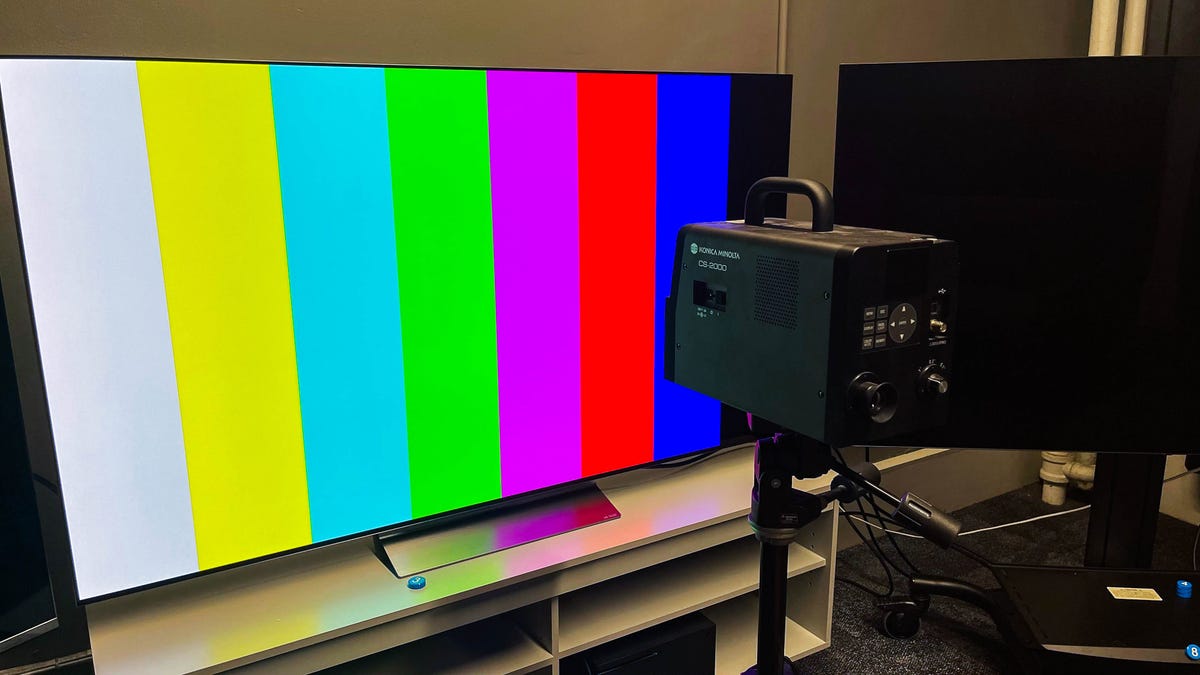
This is where the heavy machinery earns its keep. The primary workhorse in that bunker is the Konica Minolta CS-2000, a highly specialized spectroradiometer that retails for roughly $28,000. In practice, it measures luminance and color accuracy with a level of precision that makes standard consumer calibration tools look like Fisher-Price toys. Paired with software like Portrait Displays’ Calman, this $28,000 flashlight in the dark spits out raw, unspun data.
A manufacturer can print “INFINITE CONTRAST” across the retail box in letters the size of your fist. The CS-2000 does not care about the box. It only cares about the math.
Why a $28,000 Machine Still Can’t Do the Job Alone
Here’s the part that surprises most people: data, stripped of context, is completely useless.
Hook a screen up to the spectroradiometer, run a signal generator through an AVPro 8×8 4K UHD Matrix Switch, collect every chart and graph the software will produce — and if you stop there, you’ve failed the reader. Numbers on a page don’t tell you what it actually feels like to run a fast-paced shooter on that display, or how the viewing angles hold up when you’re slumped sideways on the far end of the couch at 11pm.
The most important piece of test equipment is an experienced eye. Test patterns and the latest gear are no substitute for a knowledgeable evaluator with a background in reviewing similar types of TVs.
CNET Methodology Report
Veteran reviewers like David Katzmaier and Ty Pendlebury — people who have logged thousands of hours staring at panels in dark rooms — are the bridge between the raw data and a meaningful verdict. They line up competing models side-by-side. They pull the curtains open to simulate a sun-drenched afternoon living room. They run voice commands, poke through smart interfaces, and clock whether the menus respond instantly or drag with that maddening half-second delay that compounds over years of daily use.
The human eye, when actually tested against instruments, turns out to be remarkably good at catching subtle motion blur that a static test pattern misses entirely. According to data compiled by Nielsen, the average American adult spends close to three hours a day watching television. Over the lifespan of a single TV, that’s thousands of hours locked onto one glowing rectangle. Minor irritants — say, an overly aggressive local dimming algorithm that causes subtitles to bloom and pulse — balloon into daily frustrations you didn’t anticipate when you were standing in the store. A machine might flag the dimming behavior. Only a human will tell you it’s going to drive you insane.
The Panel Lottery Nobody Warned You About
Now for the counterargument that keeps enthusiast forums occupied for months at a time.
When a reviewer tests a television — even with $28,000 worth of equipment and decades of experience behind them — they are evaluating a single unit. Manufacturing tolerances in consumer electronics are, typically, looser than most buyers assume (per industry analysis published by DisplayMate Technologies). The unit sitting on a Best Buy shelf six months after a review drops might carry a panel sourced from a secondary factory, or a marginally different power supply. Performance can shift from box to box in ways that are real and measurable.
Then there’s the firmware problem. Modern televisions are, functionally, large computers bolted to a glass panel. Manufacturers push over-the-air updates constantly — updates that can radically alter how a TV actually performs in your living room. One pushed patch might eliminate a gaming input lag issue that plagued early units. Another might accidentally crush shadow detail in HDR content, making dark scenes in prestige dramas look like they were shot through a muddy lens. A review is a snapshot. It’s a static judgment of a product that keeps quietly shifting beneath you.
So does the review even matter?
Unambiguously yes. Sample variance is real, but a rigorous baseline beats flying blind by a wide margin. If a model ships with poor color accuracy, sluggish menus, and underwhelming peak brightness out of the box, a firmware update is unlikely — in most cases — to transform it into a top-tier product. The foundational engineering is either there or it isn’t. No software patch closes that gap.
Golden Samples, PR Pressure, and the Independence Problem
There’s a murkier dimension to hardware reviewing that rarely gets discussed openly: brand manipulation.
Most of the time, media outlets receive review units shipped directly from manufacturers. A PR contact sends a shiny new box to the lab, and testing begins. That arrangement creates a glaring vulnerability — one the industry has quietly lived with for years. What stops a struggling manufacturer from sending a “golden sample”? A unit quietly cherry-picked off the assembly line, hand-calibrated at the factory, and polished to perform well above what a retail consumer would actually receive?
It happens. Reviewers know it happens. If a lab catches blatant evidence of tampering, they’ll call it out publicly — but proving deliberate manipulation is notoriously difficult, and the incentives cut hard against transparency.
Independence is, for this reason, non-negotiable. When a manufacturer gets evasive, refuses to provide a specific model, or tries to attach conditions to a review — dictating which modes can be tested, or which software version must be installed — a credible publication simply goes out and buys the television at retail. No special handling. No pre-selected panels. Just the identical consumer experience you’d have walking out of the store yourself.
That distinction matters enormously. When a rigorous outlet finally stamps an “Editors’ Choice” badge on a product, it carries real weight. The product survived the dark room. It survived the spectroradiometer. It survived the side-by-side human gauntlet conducted by people who’ve seen thousands of panels and know exactly what they’re looking at.
Do firmware updates ruin the accuracy of older reviews?
They can certainly shift the math. Major updates sometimes alter brightness caps or resolve gaming bugs that plagued earlier firmware. Smart buyers use reviews to assess the hardware’s baseline capability, understanding that software quirks — for better or worse — tend to evolve over a product’s lifespan.
Why are side-by-side comparisons so critical?
Human visual memory is surprisingly unreliable. Watch a film on TV A, then watch the same scene on TV B an hour later, and your brain struggles to reconstruct the exact black levels you saw before. Viewing both panels simultaneously is the only reliable way to surface subtle differences in contrast, color volume, and shadow rendering.
The $28,000 Case for Doing Things the Hard Way
We’re living through a strange inflection point in media. Everything is collapsing toward frictionlessness. A thousand words of buying advice now takes about forty-five seconds to generate. Aggregating Amazon star ratings and repackaging them as editorial judgment has become, in some corners of publishing, an accepted business model. Nobody bats an eye.
Rigorous hardware testing runs entirely against that current. It’s slow. It occupies significant physical space — a blacked-out room that produces zero content on the days it’s being calibrated. It demands tens of thousands of dollars in specialized equipment that depreciates and requires maintenance. Most of all, it requires human beings to sit in dark rooms for hours at a stretch, staring at test patterns until their vision starts swimming, then doing it again with the curtains open, then doing it again with a competitor’s panel placed directly alongside. There is no shortcut that preserves the result.
But that friction — that stubborn, expensive, time-consuming resistance — is precisely where the truth lives. When you finally commit to a 77-inch screen for your family room, the peace of mind you’re buying isn’t just about the panel. It’s about knowing that someone actually did the homework: sat in the dark, ran the numbers, and called the result honestly regardless of who sent the box.
A $28,000 machine might read as overkill to most people making a $1,500 purchase decision. In a media landscape built on shortcuts, though, overkill is exactly the point.
Source material compiled from several news agencies. Views expressed reflect our editorial analysis.